
Meta Muse: From AI that answers to AI that acts
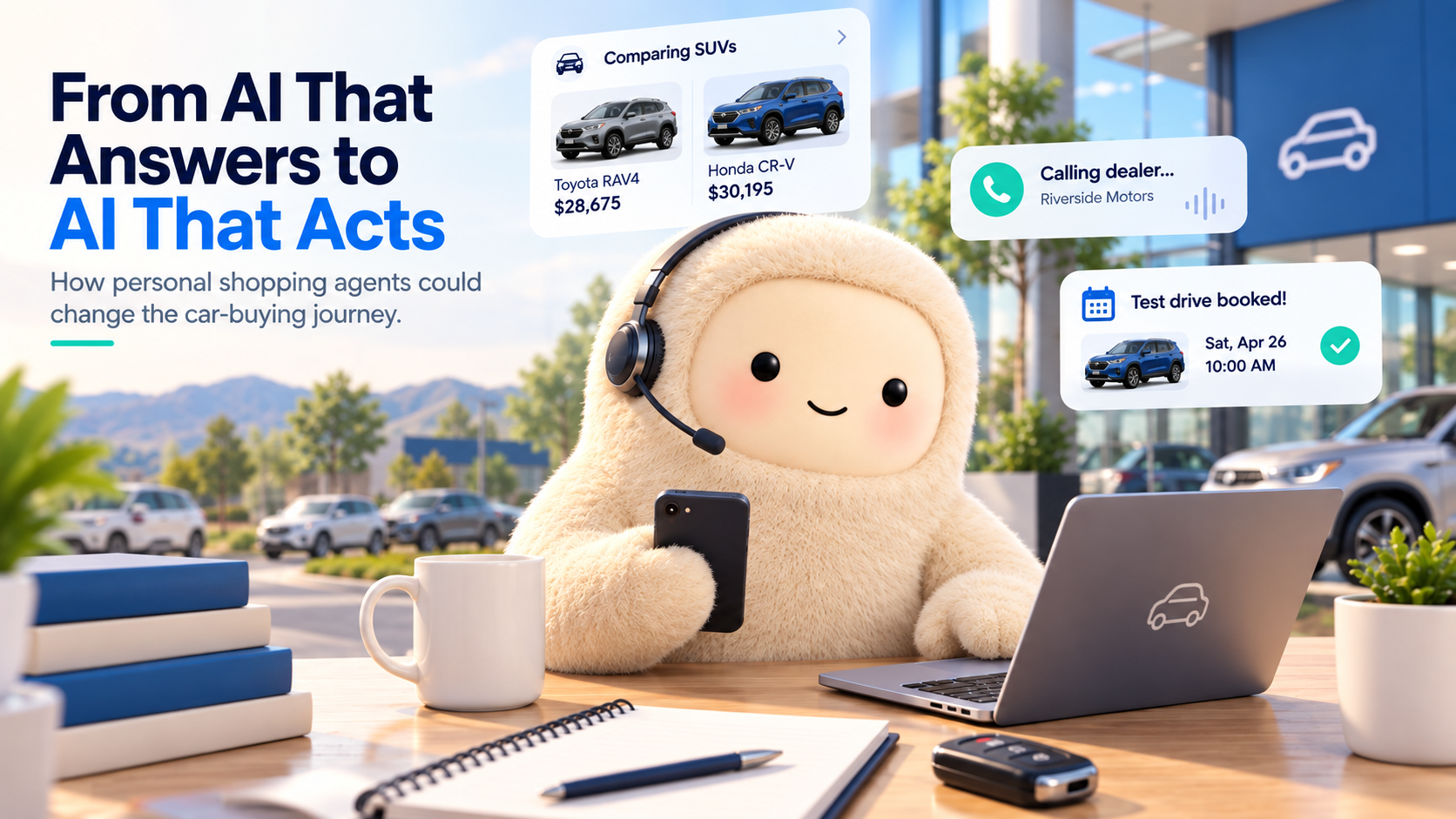
Meta launched its new consumer-focused AI agent, Muse, two weeks ago. We started playing with it almost immediately. So far, I'm impressed.
Not necessarily because Muse has the smartest underlying AI model I've used. It doesn't. What's interesting is the product Meta has built around the model, what people are already using it for, and perhaps most importantly, who Meta can put it in front of.
For most consumers, generative AI has still primarily been about asking questions.
- Write this email.
- Explain this concept.
- Research this topic.
- Plan my trip.
- Compare these products.
Muse is built around a different idea: AI that doesn't just answer, but actually does the work.
You give it a task, and it goes to work. It has its own browser, can interact with websites and connected services, fill out forms, send emails, shop, make purchases, and keep working after you close the app. Meta describes it as a personal AI agent built to take on tasks and projects rather than simply respond to prompts.
Personal agents have been coming for a while
Meta didn't invent the personal AI agent. The current wave really started breaking into view with products like OpenClaw. OpenClaw showed what becomes possible when you combine a capable model with persistent memory, access to tools and a computer, and the ability to actually act on someone's behalf.
Instead of opening a chatbot every time you have a question, you could have an agent running continuously, connected to your apps and communication channels, and hand it actual work.
It was a big idea and became a breakout product among AI power users. But it was also very clearly built for power users.
Even today, getting OpenClaw running can involve installing software, configuring a local Gateway, authenticating models and connecting services. Its setup documentation includes command-line installation and configuration that will look completely normal to a developer and completely foreign to most consumers.
Then came products like Grok Bot, which gives persistent agents their own computers and lets them work across apps. But its initial positioning and examples skew heavily toward professional work like sales, marketing, operations and engineering.
Instinct pushed the idea much closer to a consumer experience. You text or call it like a person while the agent uses a phone and computer behind the scenes. People are using it for things like travel, reservations, shopping, appointments and other everyday tasks. But it remains invite-only and has largely spread so far among Silicon Valley and AI early adopters.
All of these products are pointing toward the same destination.
There's very little to understand. You tell it what you want done and watch it work. It is available in a standalone app and through WhatsApp, and Meta has designed it explicitly around a mass consumer audience.
And behind that experience sits one of the largest consumer distribution networks in the world. That combination could make Muse a tipping point.
The model isn't actually the most interesting part
We've pushed Muse beyond simple consumer tasks into some fairly complicated development and integration work. That's where its limitations become clearer.
In our experience, the underlying intelligence can sometimes feel more like using ChatGPT or Claude from 8 to 12 months ago than using today's best frontier models. It can also be surprisingly confident when explaining technical details about its own capabilities and limitations, only for those explanations to turn out not to be right.
It's definitely early. But I've started to think that focusing too much on the model quality misses the bigger point.
Does a personal agent need to be the smartest AI model in the world? For complicated software development or difficult reasoning problems, it helps.
- But to research a purchase?
- Cancel a subscription?
- Compare prices?
- Make a reservation?
- Fill out a form?
- Schedule an appointment?
- Call a business?
Probably not.
For a huge class of consumer workflows, the winning product may simply need to be smart enough, have the right tools and be trusted to actually get things done. Muse already feels surprisingly capable at that combination.
What people are actually using it for
It's early, but we're already getting enough public usage to see some patterns. Most of the interesting Muse use cases aren't science fiction. They're things people already do and would rather not do themselves.
- Dealing with customer service.
- Finding savings.
- Shopping.
- Making reservations.
- Researching travel.
- Handling administrative tasks.
FUNDA recently analyzed 654 publicly shared Muse use cases and found that roughly 63% fell into what it broadly categorized as "life admin." Shopping alone represented 9.5% of the examples.
That reinforces what we've felt while using Muse: The consumer opportunity may not require the world's smartest model. A lot of the value comes from having software willing to spend 20 minutes doing something you don't want to spend 20 minutes doing yourself.
And automotive examples are already starting to show up.
Muse is already showing up in the car-buying process
Nick Prince recently posted about using Muse while buying out his leased vehicle. Something about the dealership's financing offer looked wrong, so he gave it to Muse.
According to his account, Muse identified a large fee associated with having the dealership handle parts of the financing and DMV process, explained the alternative, and helped him understand how he could handle much of it himself.
He also used Muse to evaluate around $250 in recommended dealer service work against his automaker's scheduled maintenance. His estimate was that Muse saved him about $1,250.
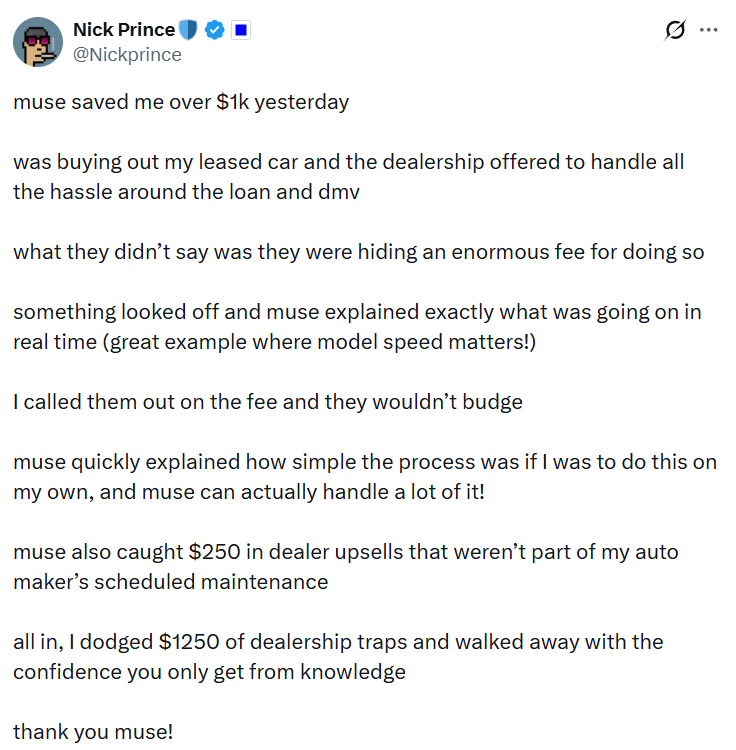
That example caught my attention because Muse didn't autonomously buy a car. It sat beside the consumer during a complicated transaction, understood what was happening and helped represent the consumer's interests. I suspect that's how agents will initially enter a lot of categories.
They won't suddenly take over the entire transaction. They'll progressively take over pieces of the research, comparison, negotiation and coordination that consumers currently do themselves.

And now agents can pick up the phone
This gets especially interesting for automotive. Meta is already testing the ability for Muse to make outbound calls to U.S. businesses. The feature is still early, and Meta is working through privacy and transparency questions around how those calls operate.
Early examples have included car-shopping tasks, like this one where Muse phoned dealerships.
Think about what that means for a dealership. A customer could eventually say:
The dealership doesn't have to integrate with a new protocol before an AI shopper can show up. The agent can just call.
That creates a completely new set of questions and potential issues for dealers and their staff.
- What happens when some inbound sales and service calls are AI agents?
- Can existing IVRs handle them?
- Should a BDC treat an agent differently from a person?
- How do you capture the identity and contact information of the actual shopper behind the agent?
- What happens when an agent calls five competing dealerships in a few minutes and asks each one exactly the same questions?
- And eventually, what happens when the dealer's AI answers the consumer's AI?
The calling behavior appears to be catching on quickly. In FUNDA's analysis, publicly shared Muse use cases involving phone calls more than doubled in just four days.
For automotive, this could matter faster than people expect because so many important parts of the customer journey still get resolved over the phone.
So we gave Muse a dealership MCP server
This was the experiment that really got our attention at CarGenius. We've been building MCP servers that allow AI systems to interact directly with individual dealerships and dealer groups. They expose things like dealership information, live inventory, vehicle details, lead and scheduling workflows in a structured way an AI agent can understand.
 +
+
So we gave Muse the MCP server for one of our dealers and started testing it. It figured it out very quickly.
We gave Muse car-shopping requests and watched it understand the available tools, search the dealer's actual inventory and retrieve specific vehicles that matched what we were looking for. Then we pushed it one step further.
Muse submitted a lead to the dealership on our behalf.
We hadn't built a special Muse shopping workflow to make that happen. We gave the agent access to the dealer's tools. It understood what those tools did and started using them to accomplish the shopper's objective.
Still early. But pretty impressive. It also made something we've been talking about at CarGenius for a while feel much less theoretical:
There may be two ways agents interact with businesses
What we're seeing with Muse points toward two parallel models. The first is pretty remarkable: Agents can use the interfaces we already built for humans.
- They can browse your website.
- Fill out your forms.
- Send you an email.
- Call your phone number.
That means businesses can't simply wait until they've built an "AI strategy." Agents can begin interacting with them through the existing customer experience.
But there is also a second model:
Give agents a structured interface designed specifically for software.
That's effectively what we did by giving Muse access to a dealer MCP server.
- Instead of asking the agent to browse around a website trying to figure out which vehicles are available, it can query inventory directly.
- Instead of calling someone and asking for information, it can use a tool.
- Instead of finding and completing a lead form, it can submit the structured data directly.
Long term, that seems much more efficient. Websites were designed for humans to look at. Phone systems were designed for humans to talk to humans. If software is on both sides of the interaction, forcing it to click around web pages or turn data into speech so another piece of software can turn the speech back into data starts to look pretty inefficient.
I suspect businesses will ultimately need both.
- Great digital experiences for humans.
- And great structured interfaces for the agents working on their behalf.
But will businesses let the agents in?
This is where the story gets more complicated. Amazon has already blocked Muse from shopping Amazon.com. Amazon says Meta didn't coordinate with it, that Muse does not identify itself while browsing, and that third-party agents operating inside authenticated accounts create security, privacy and transparency concerns. Amazon has also been fighting similar battles with other AI companies over agentic shopping.
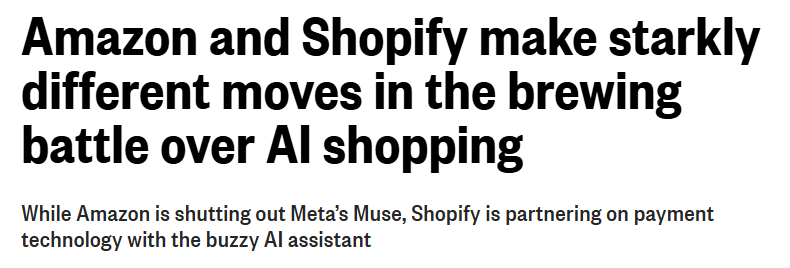
Shopify is taking almost the opposite approach. Rather than trying to keep agents out, Shopify added Meta as an AI commerce channel. Eligible merchant products can be shared with Meta through Shopify Catalog, and merchants can manage whether they participate in direct checkout.
Stripe is pushing in the same direction. Muse can use Link to complete purchases at more than one million businesses that accept it, and Link can issue a single-use virtual card for approved purchases elsewhere.
That Amazon versus Shopify contrast may be a preview of one of the most important fights in agentic commerce:
There are legitimate reasons to worry about security, privacy, reliability and automated systems operating inside customer accounts. But there are also enormous commercial stakes.
If I send my agent shopping instead of browsing Amazon myself, Amazon potentially loses control over part of the discovery process.
- The agent decides what gets considered.
- It decides which information matters.
- Potentially, it decides which merchants get contacted.
That raises much bigger questions.
- Who controls product discovery when the shopper is software?
- Where does advertising fit?
- Who owns the customer relationship?
- And what does it mean to be "visible" when the customer isn't browsing the web at all?
Those questions matter a lot in automotive too.
Why Meta could be the tipping point
None of this means Muse is the first personal agent.
- OpenClaw demonstrated how powerful the model could be for sophisticated users.
- Grok Bot brought always-on agents into professional workflows.
- Instinct showed how much more approachable the experience gets when you can simply text an agent and let it use a computer for you.
But those products have largely spread through developers, AI enthusiasts, Silicon Valley insiders and early adopters. Meta operates on a fundamentally different scale. Facebook, Instagram, WhatsApp and Messenger are already part of everyday life for billions of people.
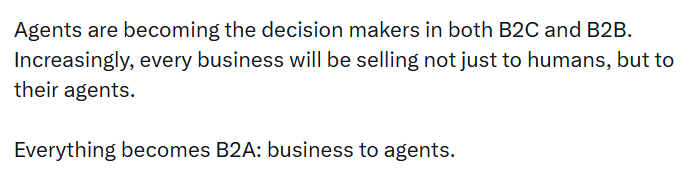
Muse doesn't need to convince consumers to learn what MCP is, configure a gateway or even understand the term "AI agent." The UX can be much simpler:
"Can you take care of this for me?"
Then it goes and tries to take care of it. That combination of a polished consumer experience and massive distribution may be more important than having the absolute best underlying model.
The early traction suggests people are responding. Muse reached 2.8 million downloads in the U.S. and Canada in its first 12 days, according to Reuters. Meta's shares have also risen more than 20% since Muse launched on September 8, adding more than $200 billion in market value, with analysts pointing to Muse's early adoption and potential as a meaningful new consumer AI business.
Obviously, a stock move doesn't prove a product will succeed, and it would be too simplistic to attribute all of Meta's market performance to one product launch. But investors clearly see the potential.
While much of the foundational AI competition continues around model capabilities, coding, developers and enterprise workflows, Meta has an interesting opportunity to focus on something slightly different:
Making the personal AI agent a mainstream consumer experience.
From AI that answers to AI that acts
Muse is still early. Our testing has exposed plenty of rough edges. Its reasoning isn't always state of the art. It sometimes confidently misunderstands its own capabilities. Browser automation can fail. Businesses can block agents. Phone calls introduce an entirely new set of privacy and disclosure questions.
There are still enormous unanswered questions around trust, security, advertising, data access and how much autonomy consumers will actually hand over. But after using Muse, watching what early users are doing with it, and seeing it interact directly with one of our dealership MCP servers, it feels like something important is happening.
OpenClaw and the first generation of personal agents showed AI insiders what this model could look like.
Muse may be the product that introduces it to everyone else.
The first phase of generative AI was largely about giving people better answers. The next phase may be about giving AI the tools and permission to act.
And for automotive, that means preparing for a world where consumers don't just use AI to figure out which car they want.
They send an agent out to shop for it.
See what AI says about your dealership
CarGenius Dealer AI Visibility Reports measure which dealerships AI assistants actually name when shoppers ask non-branded Find, Buy, and Service questions, which competitors win those recommendations, and which sources are shaping the answers. See where your store stands.
View the Visibility ReportsGet a Custom ReportOr book a demo →
Jev and the Falling Cost of AI Intelligence
We tested TypeSafe's new decision model, Jev, on real CarGenius workloads. The results point to a future where specialized AI makes a much larger class of software automation practical.
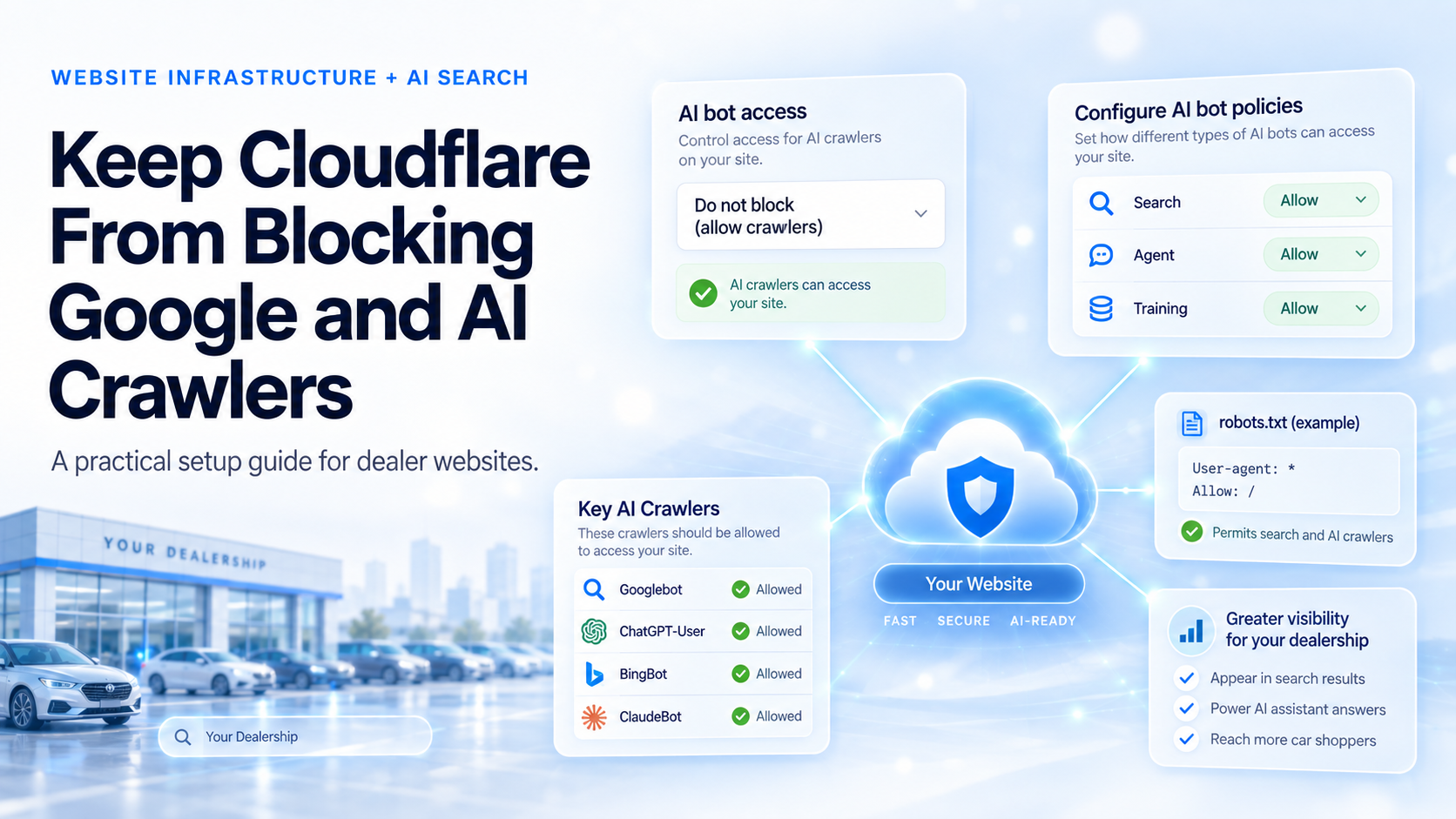
How to Keep Cloudflare From Blocking Google and AI Crawlers
Cloudflare now separates Search, Agent and Training crawlers. Here's how dealer website teams can preserve Google and AI search access while choosing their AI training policy.
of car shoppers now start with AI
higher conversion with AI search
instant answers for every shopper
Stay ahead of the curve
Get weekly insights on AI, automotive commerce, and dealer tech delivered to your inbox.