
How Google AI Overviews, AI Mode and Gemini Differ
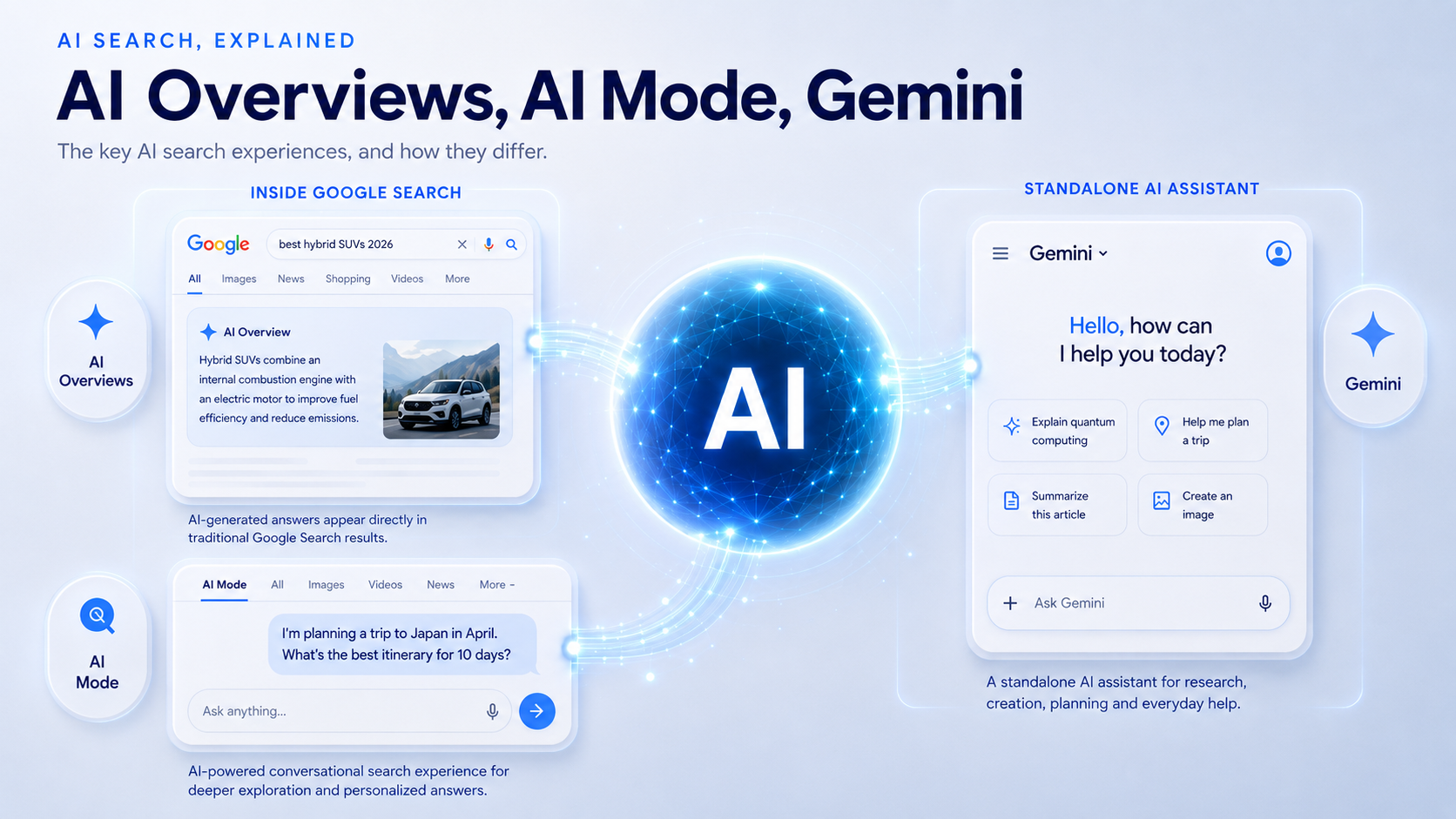
Much of the confusion around AI search starts with Google's own products. Ask ten people to explain the difference between Google AI Overviews, AI Mode and Gemini, and you will often get ten different answers. That confusion is understandable. The products overlap. They use the same family of Gemini models. They all answer questions. But they are not the same experience, they are not used the same way, and they should not be measured the same way - and if you mix them together, it becomes much harder to understand AI-search behavior, traffic and visibility.
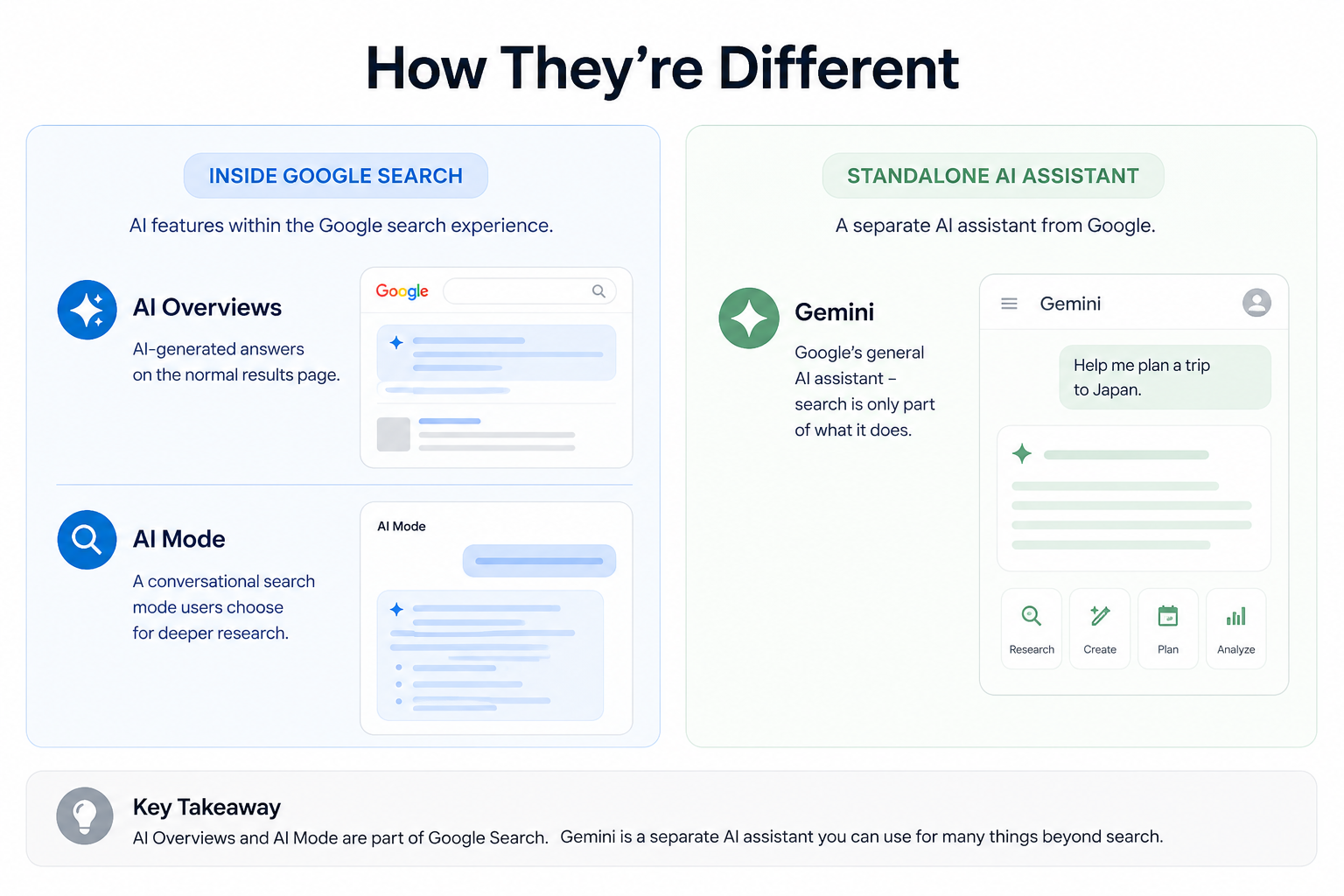
AI Overviews is an AI answer placed inside a normal Google search results page.
AI Mode is Google's more conversational, research-oriented search experience.
Gemini is Google's standalone general AI assistant, which can help with research but also many non-search tasks.
Our estimated monthly U.S. search-like activity
Modeled estimates, not platform-reported totals. How each was built is shown in its section below.
Why the distinction matters
The difference matters because these products represent different user intents, different surfaces, and different ways information is discovered and presented.
Appears in ordinary Google searches
Piggybacks on traditional Google Search volume. Users may not even consciously decide to use an AI product. They simply search on Google and receive an AI answer.
Users choose it for deeper research
A much clearer signal of research intent. The user is opting into a more back-and-forth experience, often for comparisons, planning or complex decisions.
Used for search and many other tasks
Spans far more than search. It can be used for questions, but also brainstorming, writing, organizing, multimodal tasks and assistant-like help across Google surfaces.
Why this is so confusing in practice
All three products use Gemini technology, but they are different user experiences. That is why it is easy to hear that "Gemini is growing," "AI Mode has passed 1 billion users," and "AI Overviews reaches 2.5 billion users," and mistakenly assume those are three versions of the same metric. They are not.
Search is changing, but not in one simple direction
The evidence does not suggest that traditional Google Search has suddenly disappeared. Google says it processes more than 5 trillion searches a year, and at I/O 2026 the company said Search query volume had reached an all-time high. What is changing is the shape of the experience around those searches.
AI Overviews now reaches 2.5 billion monthly users. AI Mode has passed 1 billion monthly users. And the Gemini app has passed 1 billion monthly users. So the right story is not that search is simply moving away from Google. It is that Google's own ecosystem is splitting into multiple AI-mediated ways to search, research and get answers.
Google AI Overviews
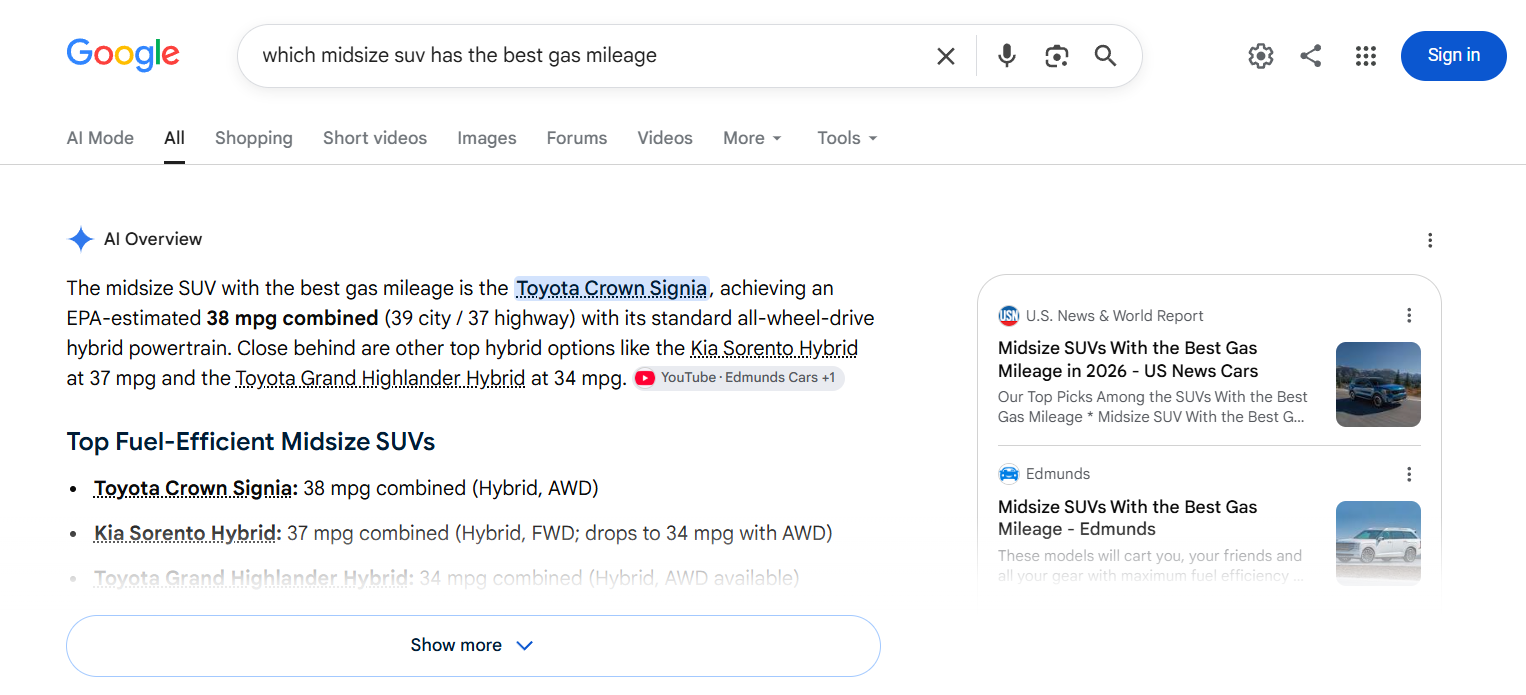
What it is: AI Overviews is Google's AI-generated summary inserted directly into the standard Google Search results page when Google decides an answer would be helpful.
How people access it: By doing a normal Google search on web or mobile. There is no separate app or destination required.
Typical user intent: Quick synthesis, answer-first information gathering, and lightweight research.
Relationship to Search: It is a feature inside Google Search, not a separate search engine.
Why it feels different from classic Google: Instead of immediately scanning the traditional results, the user may see a synthesized answer before or alongside those links, so discovery can happen before any organic click.
What to remember: AI Overviews is a subset of Google Search, not a separate demand pool. It does not represent extra searches. It represents Google searches where the results page itself now contains an AI-generated answer.
showing an AI Overview
The ~80B denominator is a floor: the 5-trillion disclosure dates to 2025, and Google says search volume has grown since.
Key sources: Google 5T+ searches, Google I/O 2026, Similarweb 2026 Generative AI Landscape Report.
Google AI Mode
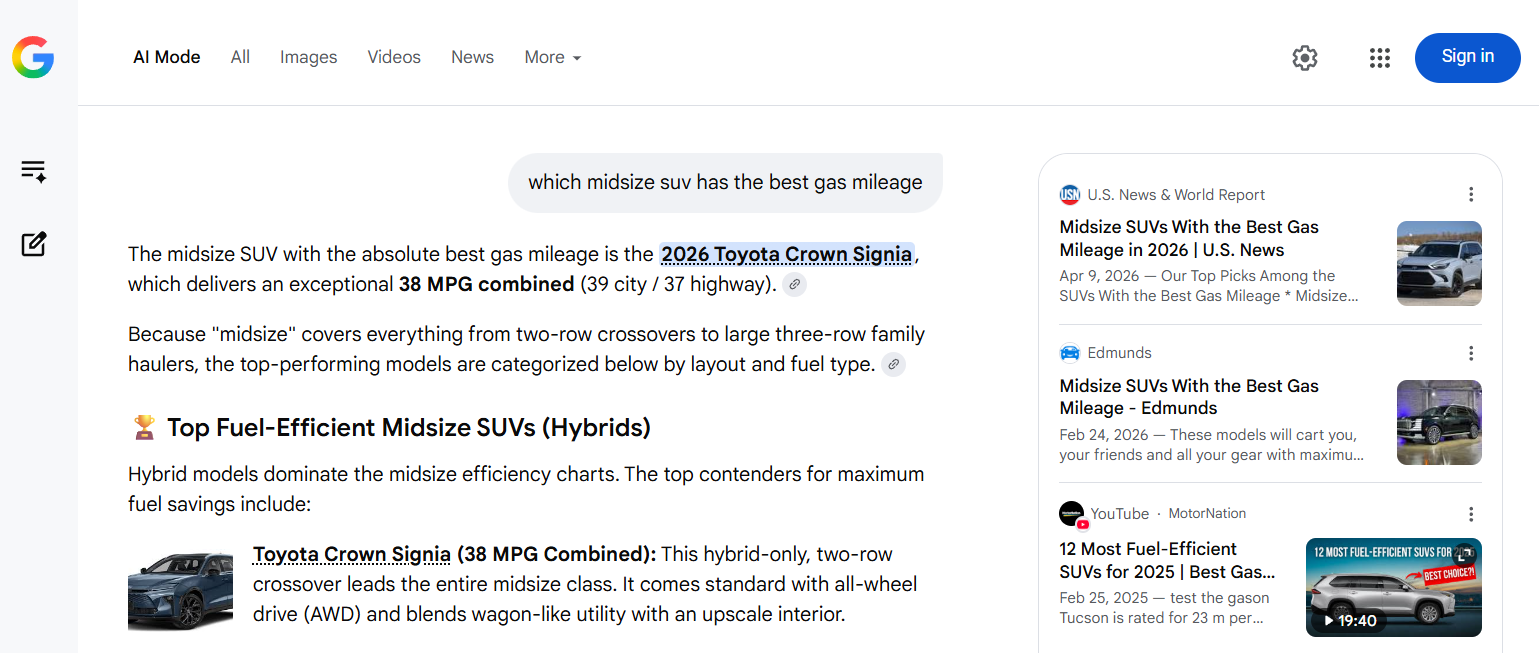
What it is: AI Mode is Google's dedicated conversational search interface. It is still part of Google Search, but it is designed for deeper exploration, follow-up questions and more complex research journeys.
How people access it: By choosing AI Mode in Search directly, or by continuing from AI-powered search results into deeper follow-up research.
Typical user intent: Comparison, planning, exploratory research and back-and-forth discovery.
Relationship to Search: It is a search-native conversational mode, closer to a research session than a standard results page.
What makes it different from AI Overviews: AI Overviews answers a search inside the existing results page. AI Mode invites the user into a separate, multi-turn research flow - the clearest sign that Google wants Search to become more conversational, not just more summarized.
The average AI Mode query is roughly 3x longer than a traditional search
The 3x query-length figure is reported by Google; the example queries are illustrative.
prompts/month
Less certain than the AI Overviews estimate: Google reports monthly users, not prompt volume, and the 4x multiplier is this estimate's biggest assumption. Directionally, it points to a very large and rapidly growing research surface.
Key sources: Google I/O 2026, Similarweb 2026 Generative AI Landscape Report.
Google Gemini
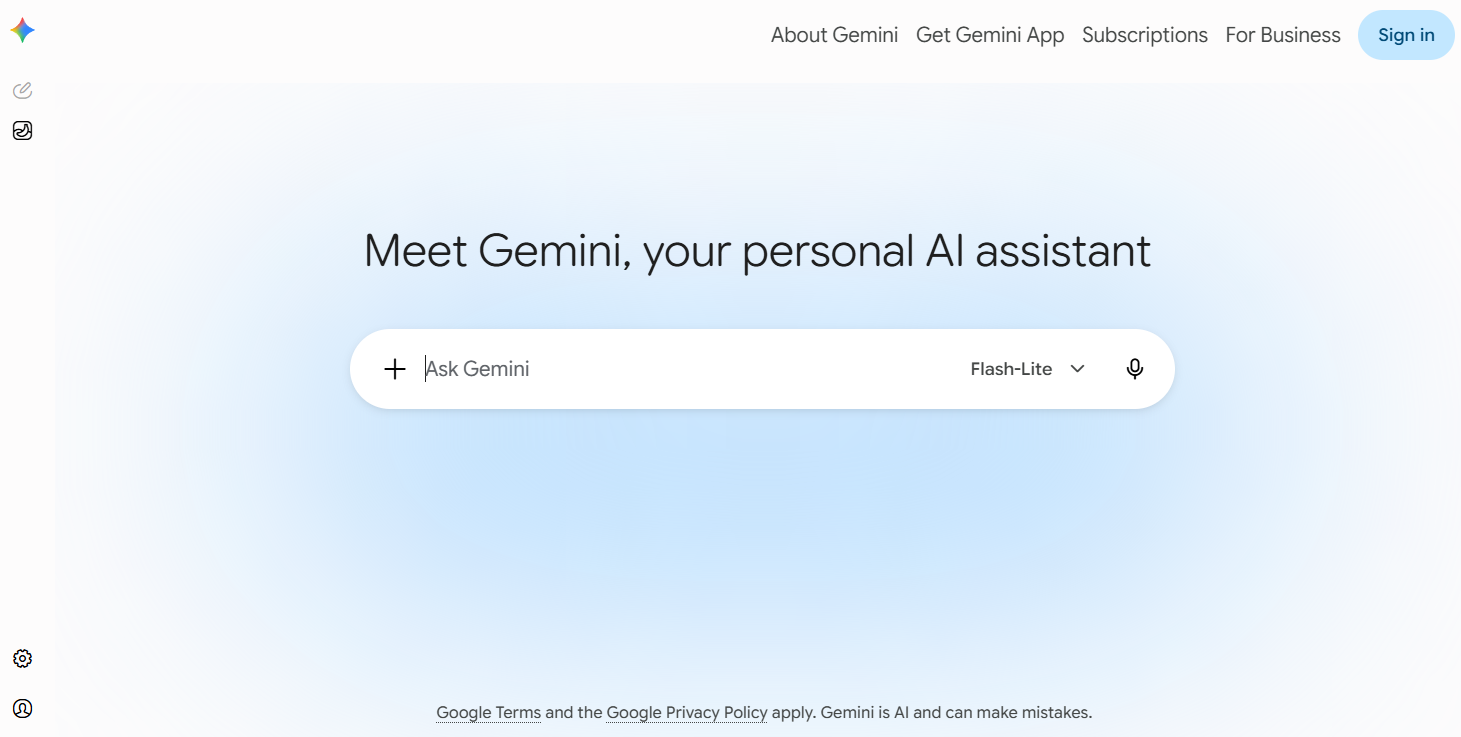
What it is: Gemini is Google's standalone AI assistant. It can handle research questions, but it also supports writing, planning, creation, multimodal tasks and assistant-like help across apps and devices.
How people access it: Through the Gemini app, gemini.google.com, Android and other Google product integrations.
Typical user intent: A mix of research, personal assistance, content creation and general problem solving.
Relationship to Search: Gemini can behave like a search assistant, but it is not limited to search behavior.
Why this gets confusing: AI Mode is explicitly a search experience; Gemini is a broader assistant. And because Google uses Gemini models across several products, people often blur the model, the app and the Search experiences into one thing.
This distinction matters when comparing usage. Google announced that the Gemini app has passed 1 billion monthly users, but that does not tell us how many of those interactions are truly search-like. A person can use Gemini to summarize notes, rewrite copy, generate ideas, or ask factual questions. That is why "Gemini users" cannot be treated as "Gemini searches."
prompts/month
A directional estimate rather than a platform-reported number: both the all-surface multiplier and the search-like share are assumptions, making this one of the more uncertain figures in the model.
Apple and Google announced a multi-year collaboration in which future Apple Foundation Models will be based on Google's Gemini models and cloud technology, including models intended to help power a more personalized Siri. That does not mean Siri becomes the Gemini app, but it does suggest Gemini technology will influence an even broader set of user experiences.
Key sources: Gemini 1B monthly users, Google and Apple joint statement, Similarweb 2026 Generative AI Landscape Report.
Side-by-side: the clearest way to remember the differences
| Product | Where it lives | How users typically get there | Best description | Key point |
|---|---|---|---|---|
| Google AI Overviews | Inside the normal Google results page | By doing an ordinary Google search | An AI answer layer inside Search | It is a subset of Google Search volume, not a separate demand pool. |
| Google AI Mode | Inside Google Search, but in a dedicated conversational mode | By choosing AI Mode for more in-depth research | Google's conversational search experience | It is a clearer signal of active research behavior than AI Overviews. |
| Google Gemini | Standalone assistant app and Google integrations | By opening Gemini directly or through Google surfaces | Google's general AI assistant | Not all Gemini usage is search-like, so user totals cannot be treated as search totals. |
Estimated search-like activity
Once the product differences are clear, the scale story becomes easier to understand. Traditional Google Search still appears to be the largest information engine by far. But a growing portion of those searches now produce AI answers, and standalone AI assistants have created a second large pool of search-like behavior.
No platform publishes directly comparable U.S. monthly query totals for these experiences. Where first-party query data is unavailable, we combine measured web activity with clearly stated assumptions for app usage, prompts per session, and search-like intent - each shown in the "How we estimated it" panels above. The AI Mode and Gemini figures carry substantially more uncertainty than the AI Overviews estimate.
Why this matters in automotive
Automotive is one of the clearest examples of why conversational search matters. Buying or servicing a vehicle involves comparisons, local discovery, specifications, pricing, financing, trade-offs and follow-up questions. That is exactly the kind of research AI handles well.
Sources: 36% and 63% from Cox Automotive, AI in Auto Retail Tracker; 25% and 19% from the Cox Automotive 2025 Car Buyer Journey Study.
These are answer events, not unique shoppers: one research journey can touch several engines, and an AI Overview appearing on a search that was already happening is not new demand. No platform publishes an automotive share of AI query volume, so we use 1% as a stated working assumption for the share of U.S. search-like AI activity that is broadly automotive-related - triangulated from observed search behavior, Cox Automotive's current research and category-level AI behavior signals from Similarweb and BrightEdge.
Key takeaways
- Do not lump Google's AI products together. AI Overviews, AI Mode and Gemini are related, but they represent different user behaviors and should be analyzed separately.
- AI Overviews is the biggest immediate answer layer. Because it rides on top of ordinary Google Search, its scale is already enormous.
- AI Mode is Google's clearest research product. It is the best signal that Google wants more searches to become conversational and multi-turn.
- Gemini is broader than search. That makes it strategically important, but also harder to compare cleanly with search products.
- Measurement now needs product-level nuance. "AI traffic" is too broad. Any comparison should distinguish which engine, which interface and which kind of behavior is actually being measured.
- Automotive is already feeling the shift. AI is no longer experimental in car shopping. It is becoming part of the real discovery and consideration process.
See which dealerships AI actually recommends.
CarGenius measures dealer visibility across ChatGPT, Google AI Mode, and Google AI Overviews - the key engines covered in this article - brand by brand and metro by metro.
View the Visibility ReportsGet a Custom ReportOr book a demo →Frequently asked questions
Are Google AI Overviews, AI Mode and Gemini the same thing?
No. They are related and all use Google's Gemini model family, but they are different experiences. AI Overviews is an AI answer inside a normal Google search results page. AI Mode is a conversational search mode the user chooses for deeper research. Gemini is a standalone AI assistant that handles many tasks beyond search.
Does AI Overviews add to Google's search volume?
No. AI Overviews is a subset of Google Search - it appears on searches people were already doing. We estimate roughly 34 billion U.S. searches per month now show an AI Overview, out of roughly 80 billion U.S. Google searches per month.
Can Gemini's 1 billion monthly users be compared with search numbers?
Not directly. Gemini is a general-purpose assistant, and much of its usage is writing, planning and other non-search work. We estimate about 1.4 billion U.S. Gemini prompts per month are search-like - a directional estimate rather than a platform-reported number.
What does this mean for car dealers?
Vehicle shopping and service research fit conversational AI well, and Cox Automotive found 36% of in-market shoppers already use AI tools as a vehicle research channel. We estimate about 380 million U.S. automotive-related AI answer opportunities per month across Google AI Overviews, AI Mode and Gemini. The practical step is to measure visibility in each experience separately rather than treating AI traffic as one thing.
Key sources
- Google: more than 5 trillion searches annually
- Google I/O 2026: AI Mode 1B users and Search query growth
- Google I/O 2026: AI Overviews 2.5B monthly users
- Google: Gemini app passes 1B monthly users
- Google and Apple joint statement on Gemini-based Apple Foundation Models
- OpenAI: 1B weekly ChatGPT users
- OpenAI: 330M+ daily U.S. ChatGPT messages
- OpenAI / NBER: how consumers use ChatGPT
- Similarweb: The 2026 Generative AI Landscape Report
- SparkToro + Datos: Search Happens Everywhere
- Cox Automotive: AI in Auto Retail Tracker
- Cox Automotive: 2025 Car Buyer Journey Study
- Cox Automotive: Fixed Ops & Ownership research
- BrightEdge: automotive branded vs. non-branded AI prompts
- Academic search-behavior study with Personal Vehicles category

Meta Muse: From AI that answers to AI that acts
Meta's new personal AI agent, Muse, takes on tasks instead of answering questions. We gave it a dealership MCP server: it searched live inventory and submitted a lead. What that means for dealers when the next shopper is an agent.

Jev and the Falling Cost of AI Intelligence
We tested TypeSafe's new decision model, Jev, on real CarGenius workloads. The results point to a future where specialized AI makes a much larger class of software automation practical.
of car shoppers now start with AI
higher conversion with AI search
instant answers for every shopper
Stay ahead of the curve
Get weekly insights on AI, automotive commerce, and dealer tech delivered to your inbox.