
Dealer AI Visibility Trends: September 2026

Google began presenting more complete dealership information in AI Overviews during September, with the sharpest dealer-relevant change being the increased visibility of review counts. AI answers also showed more addresses, phone numbers, opening hours and side-by-side comparisons. The same period brought a sharp rise in employee names, new service-booking exposure for an independent repair chain, and a drop in sponsored cards within the initial ChatGPT answers we tracked. Separate informal October checks found ads appearing later in some conversations.
These shifts do not all measure the same thing, but they share a practical consequence: shoppers are getting more of the information they need within an AI answer, sometimes without visiting a dealership website. Below is the comparison from CarGenius tracking, followed by what changed, why it matters, and what dealers can do.
What changed from August to September?
Four observed shifts stood out in CarGenius tracking. Each row measures a different feature of AI answers, not a dealer visibility score. The comparison windows are shown in every cell because they do not all cover two complete calendar months.
These four comparisons come from CarGenius AI answer tracking. The dates and limitations are included so the changes can be read accurately.
| AI platform and metric | August reference | September readout | What we can conclude |
|---|---|---|---|
| AI Overviews Answers showing a review count | 20%Aug 14-Sept 10 | 54%Sept 18-Oct 12 | More detailed dealership information began appearing on Sept 18. Review counts, addresses, phone numbers, opening hours and comparison tables all became more common. |
| AI Overviews Answers naming ≥1 employee | 0.8%June 30-Aug 31 | 26.1%Sept 18-Oct 7 | Named-employee mentions rose markedly, especially after Sept 18. The later window extends into October. |
| AI Mode Service answers crediting one independent chain | 2.5%Aug 1-24 | 10.5%Sept 1-30 | The booking-page source appeared in more answers. A late-August change in source recording limits like-for-like source comparisons. |
| ChatGPT Initial answers displaying ≥1 ad | 67%Aug 1-19 | 0%Sept 1-30 | None appeared in tracked first responses after Aug 26. Separate informal October tests found sponsored placements in some second responses, which this dataset does not measure. |
Scope: AI answers to tracked dealership questions across 25 metropolitan areas. Each row uses its own question set and observation period. These are not dealership recommendation rates, and the figures should not be averaged together.
Google AI Overviews are turning into detailed dealership profiles
In September, Google AI Overviews began providing more of the information shoppers usually find on a dealership's Google Business Profile. Instead of a brief list of local stores, many answers now include review counts, addresses, phone numbers, opening hours and comparison tables.
The shift became visible in mid-September. From August 14 through September 10, 20% of tracked AI Overview answers included a dealership review count. From September 18 through October 12, that increased to 54%. The same period also saw dealership comparison tables rise from 2.9% to 28.8%, street addresses from 32% to 62%, phone numbers from 6.5% to 19.2% and opening hours from 5.1% to 25.2%.
These were not isolated examples from one market. The increase began within a single collection period on September 18, and the analysis found the higher level across the groups measured afterward. Google still varies how much detail it provides, so a shopper will not see the full profile format on every search.
For dealers, the review-count increase may be the most important part of the shift. Once review volume appears directly in the AI answer, a shopper can compare stores without clicking through to another page. That makes review accumulation and reputation management more visible at the exact moment Google is helping a shopper narrow their options.
Google AI Mode also showed how much information can come directly from Google's local business data. During four live checks on October 13, three AI Mode answers listed only Google Business Profile place pages as sources. The ratings and review counts shown in those answers matched the corresponding profiles. These are illustrative checks, not a measure of how frequently that happens. Separate live attempts did not display an AI Overview, so the AI Overview percentages come from the larger tracked dataset.
Details that used to require a visit to your website may now appear directly in Google's answer. A weak review profile, a lower review count than nearby competitors, incorrect service hours or an outdated phone number can all shape a shopper's first impression, especially when dealers are shown side by side.
Audit your Google Business Profile as carefully as your website. Pay particular attention to review volume, review quality, sales and service hours, phone routing, address, services and appointment links. Review what Google says about your store, and check how your details appear next to local competitors in AI Overviews.
Google is naming dealership employees in its AI answers
As Google began showing fuller dealership information, it also started naming the people customers praise. Individual salespeople and service advisors now appear much more frequently in Google AI Overviews, particularly in answers about reputation and service.
The change became especially clear on September 18. From then through October 7, about one in four tracked AI Overview answers included an employee name. Reputation questions led the way: 59% of those answers named a person. Service-related questions followed at about 37%.
The names usually appeared in positive descriptions of the customer experience, often drawn from Google review summaries. In the tracked naming answers, the analysis found positive language essentially every time; that does not mean every customer experience was positive.
Customer reviews can give individual employees visibility inside Google's answer, before a shopper visits your site. A service advisor or salesperson mentioned repeatedly may become part of how a dealership is described.
Ask customers for authentic, specific reviews, without scripting the wording or requiring names. Check how Google describes your staff, correct outdated employee details on your website, and address recurring service concerns visible in reviews.
Independent repair shops are getting a direct path to service appointments
Google AI Mode began crediting one independent repair chain’s appointment pages far more often on dealership-service questions. The most immediate implication is for fixed operations: shoppers can encounter a competing shop and a path to book service within the same answer.
Starting in late August, booking pages for Christian Brothers Automotive began appearing much more often as credited sources in Google AI Mode. In the 14 tracked markets where the chain operates, those pages appeared in roughly one in five service answers in the August 25 to October 7 period.
Most of the credited pages were not generic homepages: 96.6% were online scheduler pages. Many appeared to come through Google's Reserve with Google booking experience, often matched to the kind of service the shopper asked about.
Franchise dealerships were still named in these answers. The independent shop was being added as another choice, often with a direct appointment option. This pattern was far more visible in Google AI Mode than in Google AI Overviews or ChatGPT.
Independent shops can appear alongside franchise service departments at the moment someone is ready to schedule maintenance. A visible booking link creates a convenient next step, though the data does not tell us whether shoppers booked.
Check that your service appointment link works on mobile and appears in Google Business Profile. Ask your website or scheduling provider which Google booking connections are supported. Then test the local service questions shoppers are likely to ask AI Mode.
ChatGPT ads may appear after the first answer
Sponsored cards stopped appearing in the initial dealership answers captured by CarGenius tracking after late August. But separate live tests in October found that ads were still appearing in some conversations, typically alongside ChatGPT's second answer after the shopper replied. The distinction matters: our tracking records the first response, not the rest of the conversation.
Ads appeared in 67% of tracked initial answers from August 1 through 19. The share fell to 26% during August 20 to 26. Across 31,194 first responses recorded between August 27 and October 4, none included an ad. That remains a valid finding about the first answer, but it does not mean ads stopped appearing in ChatGPT.
In separate, informal live tests reported in October, CarGenius observed sponsored placements generally appearing with the second ChatGPT response, after a shopper had replied to an initial recommendation or follow-up question. These tests were not part of the monthly tracking, and they do not establish how often it happens or whether ChatGPT deliberately delays ads. Read our related article, ChatGPT Is Asking Car Shoppers More Questions. Here's Why Dealers Should Care, for the examples and limitations.
Ads are labeled separately from ChatGPT's unpaid dealership recommendations. A shopper may see an initial shortlist of dealers, provide more details about a vehicle, budget or service need, and then see a sponsored placement alongside a subsequent answer. Whether those added details influence ad timing or targeting has not been established by this research.
An ad may reach a shopper after they clarify what they want, even when no ad appears with the first recommendation. Dealers should treat being named in an unpaid answer and appearing in a sponsored placement as two separate kinds of exposure.
When reviewing ChatGPT, look at both the initial recommendation and what happens after a realistic follow-up question or selection. Record unpaid dealer recommendations separately from any sponsored cards, and assess advertising only when its placement and performance can be measured.
What dealers should check this month
The month’s findings point to two practical checks that dealership teams can make now.
Check your Google Business Profile and how it appears in AI answers.
Verify sales and service hours, phone numbers, address, services and appointment links. Compare the profile information in Google AI Overviews against your real operation and nearby competitors, and look at review themes and staff references.
Test the path from service recommendation to appointment.
Confirm your service links, mobile booking flow, and available Google scheduling connections. Compare your experience with independent shops in your area. Add service booking to your MCP server so AI assistants can schedule appointments directly, and plan to support agent-to-agent (A2A) booking later.
See what AI says about your dealership
CarGenius Dealer AI Visibility Reports measure which dealerships AI assistants actually name when shoppers ask non-branded Find, Buy, and Service questions, which competitors win those recommendations, and which sources are shaping the answers. See where your store stands.
View the Visibility ReportsGet a Custom ReportOr book a demo →CarGenius tracked questions about finding, buying from and servicing at local dealerships across 25 metropolitan markets, with multiple cities in each market. The analysis covers Google AI Overviews, Google AI Mode and ChatGPT; collections were taken for different vehicle manufacturers at different times. Comparisons here describe features of recorded answers rather than an overall dealership visibility score.
The detailed-profile measures compare Aug 14-Sept 10 with Sept 18-Oct 12, 2026 (11,863 and 14,735 tracked AI Overview answers, respectively). The source analysis removed answers that were incorrectly recorded in the AI Overview channel. The September 18 increase appeared during a collection period for the same manufacturer. Google may still show a shorter format in some searches. The independent-service and employee analyses have their own date ranges, shown beside the charts. Google source-link capture changed in August, so source-citation rates across that transition are not direct like-for-like comparisons. Spot checks illustrate behavior but cannot establish prevalence. The ChatGPT ad chart uses first-response tracking only; separate informal October live tests identified sponsored placements with some second responses, without measuring their frequency or cause.

ChatGPT Is Asking Car Shoppers More Questions. Here's Why Dealers Should Care.
New CarGenius data shows a sudden rise in follow-up questions about vehicles, budgets and service needs, adding another step to how shoppers find dealerships.
Meta Muse: From AI that answers to AI that acts
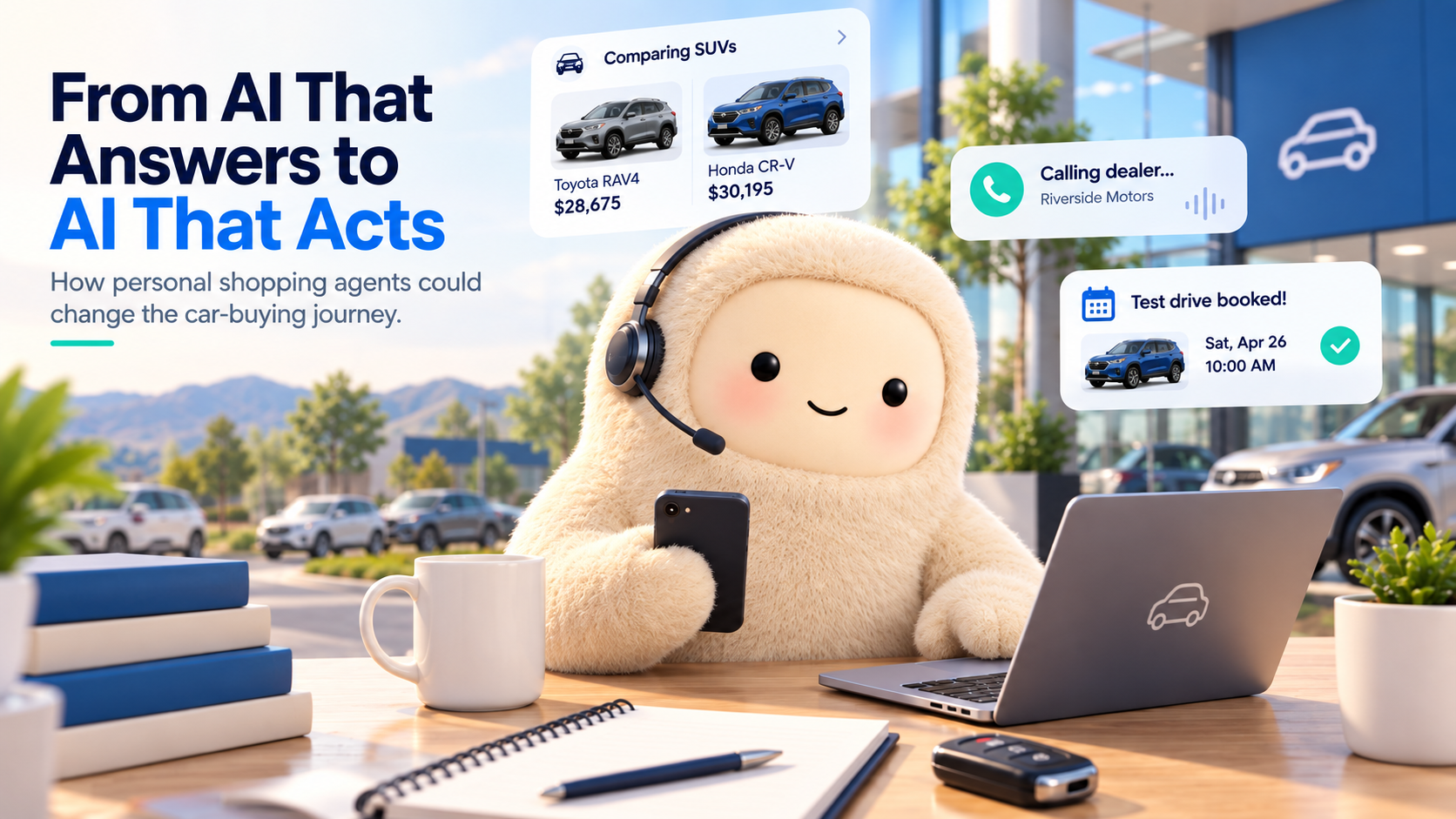
Meta's new personal AI agent, Muse, takes on tasks instead of answering questions. We gave it a dealership MCP server: it searched live inventory and submitted a lead. What that means for dealers when the next shopper is an agent.
of car shoppers now start with AI
higher conversion with AI search
instant answers for every shopper
Stay ahead of the curve
Get weekly insights on AI, automotive commerce, and dealer tech delivered to your inbox.