
ChatGPT Is Asking Car Shoppers More Questions. Here's Why Dealers Should Care.

A shopper asks ChatGPT to recommend a dealership. ChatGPT names a few stores and explains the choices. Increasingly, it now takes another step: asking what vehicle the shopper wants, how much they plan to spend, or what service their car needs.
The timing is striking. OpenAI introduced GPT-6 with Intelligent UI on October 7, making it possible for ChatGPT to combine written answers with buttons, forms and other interactive elements. On October 8, the share of tracked dealer answers asking shoppers a follow-up question jumped sharply.
Across the 68 days before October 8, just 0.5% of tracked answers asked a follow-up question. Over the next five collection days, 39.9% did. The timing is consistent with the rollout, although the CarGenius records do not identify the model behind each answer or prove that Intelligent UI caused the change.
OpenAI launched Intelligent UI just before the shift
OpenAI described Intelligent UI as a way for ChatGPT to build a more useful response for each question, including interactive choices and forms. The company began rolling it out to paid ChatGPT plans on October 7, 2026, with Free and Go following on October 8. Read OpenAI's announcement.
GPT-6 brings forms, selectable choices and other interactive elements to ChatGPT's answers.
37.3% of tracked dealer answers ask a shopper question, up from zero in the preceding day's sample.
These events occurred one day apart, but the timing does not establish cause and effect. What the data does show is a clear change in how ChatGPT answers the same kinds of local dealership questions.
What changed in dealer answers on October 8
On October 7, none of the 1,133 tracked ChatGPT answers asked the shopper a follow-up question. On October 8, 282 of 756 answers did. The pattern continued through October 12, ranging from about one-third to nearly half of answers each day.
These were mostly additions to otherwise complete answers. ChatGPT typically named dealerships first, then used the closing section to offer a more focused comparison. In 1,445 of the 1,502 answers that asked a question after October 8, the first question appeared in the final 30% of the response.
The questions depend on what the shopper needs
ChatGPT did not ask every shopper the same thing. Questions about service triggered follow-ups most often, while general dealership-finding questions triggered them least often.
Questions about the kind of vehicle a shopper is looking for.
Model or trim preferences, often followed by a budget question.
Vehicle model, model year and the work the owner needs done.
Among answers that asked a follow-up, 78% of Buy answers asked about a vehicle model or trim, and 52% asked about budget. For Service answers, 66% asked what work the vehicle needed. These categories can overlap because one answer can ask more than one question.
Shopper asked: “Where can I find new Cadillac Escalade inventory near Minneapolis, MN? Which dealerships have the most in stock currently?”
Excerpt from the end of a tracked ChatGPT answer, October 9. The full response offered multiple-choice options for each question.
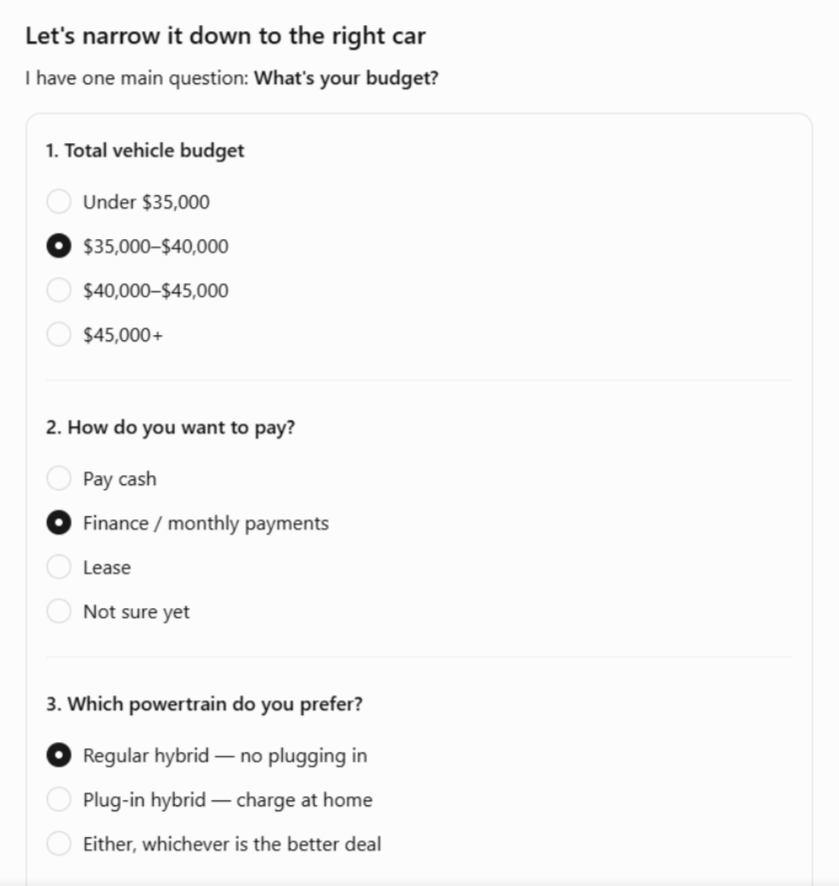
Live ChatGPT example provided October 12. This screenshot illustrates the interactive interface. CarGenius tracking captures the answers as text, so it cannot verify which individual tracked answers displayed clickable buttons.
Why the follow-up matters for dealers
A question such as “What's the best Cadillac dealership near me?” can be answered with a short list based on general reputation, location and dealership information. But a shopper looking for a particular Escalade trim under a specific budget needs a more precise answer. So does an owner looking for transmission repair on an older GMC truck.
That gives detailed dealership information a practical role. Current vehicle listings, specific service offerings, pricing where available, and useful ownership details can all help a shopper determine whether a store fits their needs. Information that is vague or difficult to find is less useful when a question becomes specific.
ChatGPT still names dealerships in the initial answer. The open question is whether the list changes once the shopper responds with a vehicle, budget or service need.
CarGenius cannot answer that second question from this dataset yet. Each tracked conversation contains only the first response, not the shopper's selections or the next recommendation. For now, the new behavior is best understood as an invitation to continue the shopping conversation, rather than proof that the dealer shortlist has changed.
Ads may be appearing later in the shopping conversation
CarGenius has noticed another pattern in separate, ad-hoc tests of live ChatGPT car-shopping conversations: sponsored placements generally appeared with ChatGPT's second response rather than its first. In those tests, the first answer tended to provide recommendations and ask what the shopper wanted. A sponsored item was more likely to appear after the shopper replied and ChatGPT responded again.
This is a preliminary observation from informal testing, rather than a finding from the tracked dealership answers. CarGenius has not systematically measured when ads appear or whether their timing is related to the Intelligent UI rollout.
One possible explanation is that the shopper's answers to ChatGPT's follow-up questions give the ad system more context to select a relevant sponsored placement. After a shopper specifies a model, budget or service need, a sponsored placement could be better matched to what that person wants. OpenAI says its ad system considers the context and intent of the conversation when selecting ads. But this remains a hypothesis: CarGenius has not tested whether those answers affect ad timing, and OpenAI has not said that ads are deliberately held until a shopper answers follow-up questions.
ChatGPT names dealerships and may ask for a vehicle, budget or service detail.
ChatGPT provides another answer. In some informal tests, a Sponsored placement appeared below it.
Illustrative conversation flow, not a measured ad-placement rate. Sponsored placements are separate from ChatGPT answers.
This Toyota Sunnyvale placement shows how a sponsored dealer offer can appear as a separately labeled card alongside a shopping conversation.
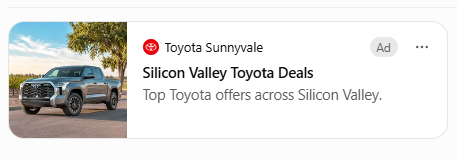
Example provided by CarGenius. The screenshot illustrates the ad format, not how frequently ads appear or which response triggered this placement.
OpenAI says ads may appear beneath responses for eligible Free and Go users, are clearly labeled and do not influence ChatGPT's answers or recommendations. That distinction matters for dealers: being named by ChatGPT and appearing in a paid placement are different kinds of visibility.
If the second response is becoming a common place for ads to appear, dealers will want to evaluate both moments separately: which stores ChatGPT recommends as the conversation gets more specific, and which sponsored placements shoppers may also see.
ChatGPT is also changing how it presents dealer websites
The follow-up questions arrived alongside longer, more structured answers. On October 7, the median tracked ChatGPT response was 3,061 characters. On October 8, it was 6,258. Numbered sections, comparisons and more descriptive headings became more common.
The way ChatGPT showed website references changed, too. From October 8-12, 53.5% of tracked answers included a link to a dealership website within the answer text. And of the 5,854 recorded links pointing to dealer websites, 85% went to a homepage rather than a specific inventory or service page.
For dealers, the immediate implication is straightforward: make it easy for a shopper arriving at your homepage to find inventory, schedule service or contact the store. At the same time, don't assume the apparent drop in citation chips means ChatGPT has stopped consulting review sites and marketplaces. In the recorded web-search results, those outside sources still appear frequently. The system's method of displaying references has changed, which makes simple before-and-after citation comparisons less reliable.
What dealers should do now
Dealers do not need to redesign their websites around a new ChatGPT screen. They do need to make the information behind a more specific shopping question accurate and accessible.
Make vehicle detail easy to find.
Keep new and used inventory, model, trim, price and availability information current. Individual vehicle pages should answer the questions a shopper would ask before visiting the store.
Be more specific about service.
Describe the services your department actually offers, the vehicle types it supports and practical details such as scheduling, hours, transportation options and published pricing where applicable.
Give visitors a clear path from the homepage.
Check how quickly a shopper can reach a vehicle listing, service appointment or contact option, especially on a phone.
The initial dealership recommendation is still an important point of visibility. As ChatGPT asks more follow-up questions, the next test may be whether a dealer remains relevant when the shopper gets specific.
See what AI says about your dealership
CarGenius Dealer AI Visibility Reports measure which dealerships AI assistants actually name when shoppers ask non-branded Find, Buy, and Service questions, which competitors win those recommendations, and which sources are shaping the answers. See where your store stands.
View the Visibility ReportsGet a Custom ReportOr book a demo →CarGenius analyzed 56,803 stored ChatGPT answers to tracked local dealership questions collected from August 1 to October 12, 2026. The before period (August 1-October 7) covers 53,041 answers; the October 8-12 period covers 3,762 answers.
A follow-up question was identified using text rules checked against samples of the answers. “With answer choices” means at least two short choices recorded directly under a question; it does not prove those choices appeared as clickable controls. Only the first answer was recorded, not any subsequent conversation. The tracking records also do not identify the model version or guarantee that all visual elements appeared identically in the live ChatGPT product. Counts and format changes could be affected in part by how answers were recorded.
Ad-placement observation: The note about ads appearing more often after the second response comes from separate informal live-product checks by CarGenius. It is not part of the tracked answer dataset, does not have a measured sample size or prevalence rate, and should not be interpreted as a platform-wide rule.
External context: OpenAI, “GPT-6 and Intelligent UI for everyone,” October 7, 2026, and OpenAI, “Ads in ChatGPT”. The October 8 step in the CarGenius data is consistent with the timing of the Intelligent UI rollout, but the data does not isolate its cause or establish a connection to the observed ad pattern.
Meta Muse: From AI that answers to AI that acts
Meta's new personal AI agent, Muse, takes on tasks instead of answering questions. We gave it a dealership MCP server: it searched live inventory and submitted a lead. What that means for dealers when the next shopper is an agent.

Jev and the Falling Cost of AI Intelligence
We tested TypeSafe's new decision model, Jev, on real CarGenius workloads. The results point to a future where specialized AI makes a much larger class of software automation practical.
of car shoppers now start with AI
higher conversion with AI search
instant answers for every shopper
Stay ahead of the curve
Get weekly insights on AI, automotive commerce, and dealer tech delivered to your inbox.