Back to Insights

AI Optimization for Dealers: What Matters
AI Visibility
AI Optimization for Dealers: What Matters

CarGenius AI is the AI infrastructure layer for automotive retail. Our mission is to put dealers in control of the AI-powered car shopping experience.

We do that in three ways:

Connect

MCP servers

We connect a dealer's live inventory and business directly to AI agents like ChatGPT, Claude, Gemini, and Perplexity.

On your site

AI Search

We bring that same AI experience onto the dealer's own website, so shoppers get real answers instead of a lead-capture chat window.

This post

AI Services

We help dealers improve how they show up across AI systems - measuring visibility, auditing stores, and fixing what holds them back.

Today I want to go deep on that third product: our methodology for dealer AI visibility, and how the first two products give us a view into this space that nobody else has. Every month we are measuring AI visibility across dealer markets, auditing individual stores in depth, and watching real consumers interact with AI on live dealer websites. The point of view in this post comes from that work.

TLDR: our AI Visibility framework

Through our work with dealers, we developed an approach to how car dealers should think about AI visibility today. The framework has two halves: what we measure, and what moves it.

What we measure

How you show up in AI answers today.

1
Intent: research vs transaction

Editorial brands win research questions. Dealers win transaction questions, where AI names specific stores. That is where we point every audit.

2
The three moments: Find, Buy, Service

AI reads different sources for each, so we score each moment separately.

3
AI Visibility and AI Sentiment

How often AI names you and in what position, plus what it says about you when it does.

4
Competition

Every number benchmarked against the stores AI actually names, in each market you serve.

What moves it

The five areas that decide the scores.

1
Reputation across the web

Cross-source agreement that your store is trustworthy.

2
Inventory AI can read

Accurate, current vehicle data AI can actually reach.

3
Your story, told on your own site

What makes your store different, written where AI can read it.

4
Content that answers real questions

The practical answers shoppers ask AI for.

5
A website AI can reach

The technical basics that let AI see all of the above.

The body of this post takes each one in turn, with the gaps we find most often.

The biggest opportunity in dealer marketing in twenty years

More car shoppers are starting with AI assistants, and the shift shows up clearly in the data:

25%
of new-vehicle buyers used AI tools during the shopping process
44%
of US adults now use ChatGPT, up from 34% a year earlier
42%
higher conversion from AI-referred shoppers than from other retail website traffic

Here is why I think this is good news for dealers.

For twenty years, the path between a car shopper and a dealership ran through intermediaries, and the dealers who paid the most got seen the most. AI changes that math. Today, AI answers are earned rather than bought. The assistant weighs what it can read and trust: inventory, reputation, service, buying experience. Then it names a handful of stores, not fifty links. That is a game dealers can win on merit.

And the window is open right now. The dealers who make themselves easy for AI to understand today are the ones AI will keep recommending as this channel grows. Most of the market has not started. CarGenius exists to help dealers capture that opportunity.

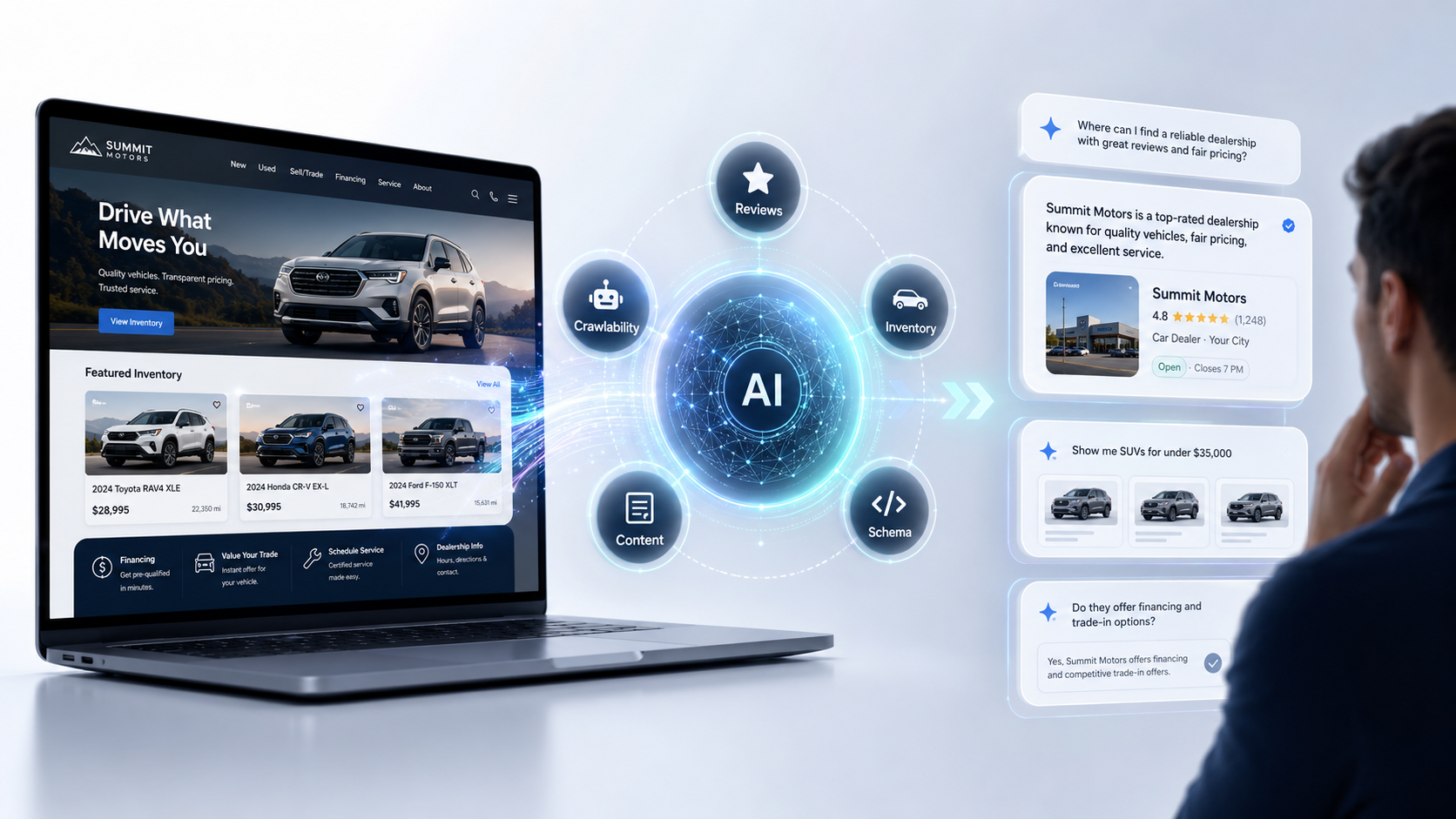
One thing worth knowing about how these answers get built: AI assembles them from what the model already knows, live web search across reviews, marketplaces, and dealer sites, and structured data, increasingly including direct connections like MCP.

What the model already knows

General automotive knowledge from training: brands, models, and the associations that come with them.

Live web search

For current questions, the assistant searches the web and reads relevant pages: reviews, marketplaces, dealer sites.

Structured data

Machine-readable information: schema on pages and, increasingly, direct connections like MCP that AI agents can query.

The answer: a short list of named dealerships

The assistant weighs freshness, relevance, consistency across sources, and the shopper's location - then names a handful of specific stores, not fifty links.

The practical goal of AI optimization is simple: show up in the sources AI checks, in a form AI can read and trust.

Research questions vs transaction questions

Not every AI answer is worth competing for, and knowing the difference saves a lot of wasted effort.

Research questions

Answered from editorial knowledge

"What is the best midsize SUV for a family of four?"
"Honda CR-V vs Toyota RAV4"

Who wins these answers National editorial brands like Edmunds and Kelley Blue Book. The shopper often never clicks anything.

A realistic dealer goal Occasional citations. A single store cannot outrank the editors here, and does not need to. This is where a lot of traditional SEO has focused. That is great, but it will not always translate into sold cars and full service bays.

Transaction questions

Answered with named dealerships

"Which Toyota dealer near me has a used RAV4 under $30,000?"
"Where should I get my Camry serviced?"
"Can I get an out-the-door price on this truck?"

Who wins these answers A handful of specific local stores that AI names directly.

A realistic dealer goal Be one of the named stores. This is where AI optimization effort turns into real business.

The transaction questions are what the rest of this post is about. This is where dealers can and should focus, and win.

The three moments that matter: Find, Buy, and Service

Transaction questions cluster around the three moments a dealership's business depends on. Every audit and report we produce is organized around them:

Find

Can buyers find you when they ask AI for help?

How AI surfaces your dealership by brand, market, or reputation.

Buy

Does AI surface your inventory at the moment of purchase intent?

How your vehicles show up when buyers ask for a specific model, price range, or feature - and increasingly when AI agents check availability, pricing, and next steps on the shopper's behalf.

Service

Is your service department in the answer?

How AI responds when drivers ask where to get their vehicle serviced.

We measure them separately because AI treats them differently. The sources it reads for a service question are not the ones it reads for a used-car question, so a store can be strong in buy answers and nearly absent from service answers without anyone noticing. And service is where retention and fixed-ops profit live.

These moments are also getting more transactional. Today the question is "which dealer has this car." Soon it is "is that car still on the lot, what is the out-the-door price, and can I book a test drive Thursday." The stores set up to answer are the stores that win the moment.

What decides whether AI recommends your store

Now the second half of the framework: the five areas that move the scores. Across the dealerships we measure and audit, AI recommends stores that are strong in each of these. Let's take them in turn.

1

Reputation across the web

Cross-source agreement that your store is trustworthy: Google, Yelp, marketplaces, consistent business details, local mentions.

2

Inventory AI can read

Accurate, current vehicle data AI systems can actually reach - on your site, on marketplaces, and through a direct feed.

3

Your story, told on your own site

What makes your store different, in words on your own pages - so AI can tell shoppers about it instead of your competitor's version.

4

Content that answers real questions

Testimonials, service and financing FAQs, current specials, and a page for every market you serve.

5

A website AI can reach

The technical basics that determine whether AI crawlers can see any of the above: crawler access, server-rendered content, clean sitemaps, and schema that matches the page.

Reputation across the web

AI looks for agreement across independent sources. A store that looks strong on one site and weak or absent on five others reads as a risk. A store that looks consistently strong everywhere reads as a safe recommendation.

The baseline everyone shares

Almost every dealer has invested heavily in their Google Business Profile, and because everyone has done it, everyone looks similar there. Keep that work up, but Google alone no longer separates you from the store down the street. The separation now happens in the sources dealers have ignored.

1
Yelp

Read by both ChatGPT and Google for local queries. An unclaimed or unanswered Yelp profile is one of the most common weaknesses in our audits, and one of the cheapest to fix.

2
Automotive marketplaces

Today, with limited alternatives, Cars.com, Edmunds, CarGurus, Carfax, and their peers are heavily read by AI when shoppers ask where to buy. A claimed, complete, accurate profile comes first. Our audits verify presence on the specific marketplaces AI cites in each market.

3
Consistent business details

Name, address, and phone identical everywhere they appear. Small mismatches quietly erode the cross-source agreement AI looks for. The most expensive version of this mistake: stores that operate under two names, where AI splits their reviews and visibility between what it reads as two different businesses.

4
Local mentions

Local news, community organizations, and sponsorships tell AI the store is an established part of its market.

More than a mention

Everything above feeds not just whether AI names you, but the sentiment score we cover in the measurement section: the exact words AI uses to describe your store. AI characterizes stores in wording pulled straight from your review record, and shoppers hear that wording first.

Inventory AI can read

Transaction questions usually end at inventory: does this dealer actually have the car? "Readable" comes down to four checks.

Visible without JavaScript

Many AI crawlers never run scripts. If listings only render in the browser, AI sees an empty page.

Structured data on every listing

Make, model, year, price, and mileage in schema markup that matches exactly what the page shows.

Real prices

Specific numbers, not "Contact for price." AI cannot recommend a car it cannot price.

Current listings

Sold cars removed promptly, prices up to date. Stale inventory erodes trust with AI systems and shoppers alike.

Where that data lives is a two-part story.

Working today

Marketplaces are the bridge

AI engines already read the major marketplaces, so accurate, current listings there put your inventory in front of AI right now, with no site changes.

Where it is heading

MCP

The Model Context Protocol gives AI agents a structured way to query your live inventory and business directly. Instead of scraping pages and hoping they are current, an agent asks "which RAV4s are in stock right now, and at what price?" and gets an accurate answer straight from your systems.

This is the core of what CarGenius builds, and it goes beyond inventory: pricing, store details, sales and service actions, all on the dealer's terms. More in our post on what MCP is and why it matters.

The next question AI will ask

As AI shopping agents mature, questions turn operational: out-the-door price, availability, booking a test drive. An agent that cannot get an answer from your systems moves on to a store where it can. The dealers standing up MCP now are ready before the agents arrive in volume.

Your story, told on your own site

This is the area most dealers underestimate.

For years, pages like About Us and Why Buy From Us were afterthoughts. They did not rank, they did not convert, and nobody read them. That era is over. When a shopper asks AI "tell me about this dealership" or "why should I buy here instead of the store across town," AI answers from what your website says about you. The pages that did not matter are now critical.

What we find in audits, again and again: about pages so generic they could describe any dealership in the country. No explanation of the buying process or what makes the store different. Selling points every dealer can recite but almost none have on a page AI can read. If it is not written down, AI cannot tell shoppers about it, and your competitor's version of the story fills the gap.

AI reads everything

Here is what surprises dealers most: AI reads everything, including the pages you forgot about. We find broken pages, outdated specials, staff who left years ago, and template content that shipped with the website. AI is forming its picture of your store from all of it. Getting your site aligned with what you want AI to know about you is now a real marketing task.

Content that answers real shopper questions

Beyond your story, AI needs material to answer the practical questions shoppers ask.


Freshness matters across all of it. A regular refresh of your key pages beats a large archive of stale ones.

A website AI can reach

None of the above counts if AI systems cannot get to it. Four checks cover most of it:


How we see what AI sees

Here is where our three products come together, and why our AI Services work is different from a generic AI visibility vendor.

Until now, AI has been a black box for dealers. You could not see what consumers were asking, what AI was telling them about your store, or where AI was getting its information. You found out you had a problem when the ups stopped coming.

Our dealers get to open the box. Dealers running CarGenius AI Search see every question consumers ask the AI on their own website, exactly how the AI responds, and where each answer came from. Full transparency into a conversation that used to be invisible, and the ability to audit it, understand it, and improve it.

What we have learned from watching

The most useful thing we have learned from watching those conversations: the majority of issues are not with the AI. They are with the information on the dealer's site. The AI faithfully repeats an outdated special, a wrong service hour, a missing financing detail. Because we can see exactly where the answer came from, we can shine a light on the problem and help the dealer fix it the same day. The same loop runs through our MCP servers, where we see how AI agents query dealer inventory and where those queries break down.

The dealers doing this now are not just fixing today's answers. They are building the muscle for a near future where AI plays a much bigger role in the consumer journey.

What we measure: visibility, sentiment, and competition

Fixing the five areas without measurement is guesswork, so here is how the measurement half of the framework works in practice. For a single store, we test dozens of shopper prompts across five AI engines: ChatGPT, Claude, Gemini, Perplexity, and Google AI Mode. We run them in every market the store serves, and we score every answer. Across each of the three moments, that produces three things:

AI Visibility

How often AI names your store, and where you land in the answer. Being the first store AI mentions and the fifth are different outcomes.

AI Sentiment

How AI describes you when it names you: the strengths and complaints it repeats from your public record.

Competition

Every number benchmarked against the stores AI actually names. Your share of the answers next to every competitor's, market by market - because a store can lead at home and be missing entirely in the next city without knowing it.

You can see the whole framework applied your store with a custom Dealer AI Visibility Report: verbatim AI answers, scores across Find, Buy, and Service, the technical foundation checks, and the full competitive picture. Our public Dealer AI Visibility Reports let any dealer see who AI recommends in their metro before spending a dollar.

What working with us looks like

An engagement starts with a full AI visibility audit of your store: the real AI answers behind every finding rather than a black-box score, graded across the framework above. Every audit ends with a prioritized action plan. Each finding is tagged on-site or off-site, rated by expected impact and effort, and written so your team or the partners you already work with know exactly what to fix first.

From there, our AI Services team monitors your visibility, position, and sentiment over time, across engines and markets, and works with you on the fixes: reputation, content, technical foundation, and the path to MCP. AI answers refresh continuously, so this is an operating discipline rather than a one-time project. The stores that treat it that way are the ones that hold the recommendation.

Where to start

The sequence we recommend:

Step 1
Measure where you stand

Visibility, sentiment, and competition across Find, Buy, and Service, in each of your markets.

Step 2
Reputation beyond Google

Keep GBP current, then put real attention on Yelp, the marketplaces AI cites, and your name, address, and phone everywhere.

Step 3
Inventory readability

Server-rendered listings, accurate structured data, real prices, and a plan for MCP.

Step 4
Content, built steadily

One substantial market page, a refreshed testimonials page, and a real Why Buy page beat a dozen thin blog posts. And run the sitemap check.

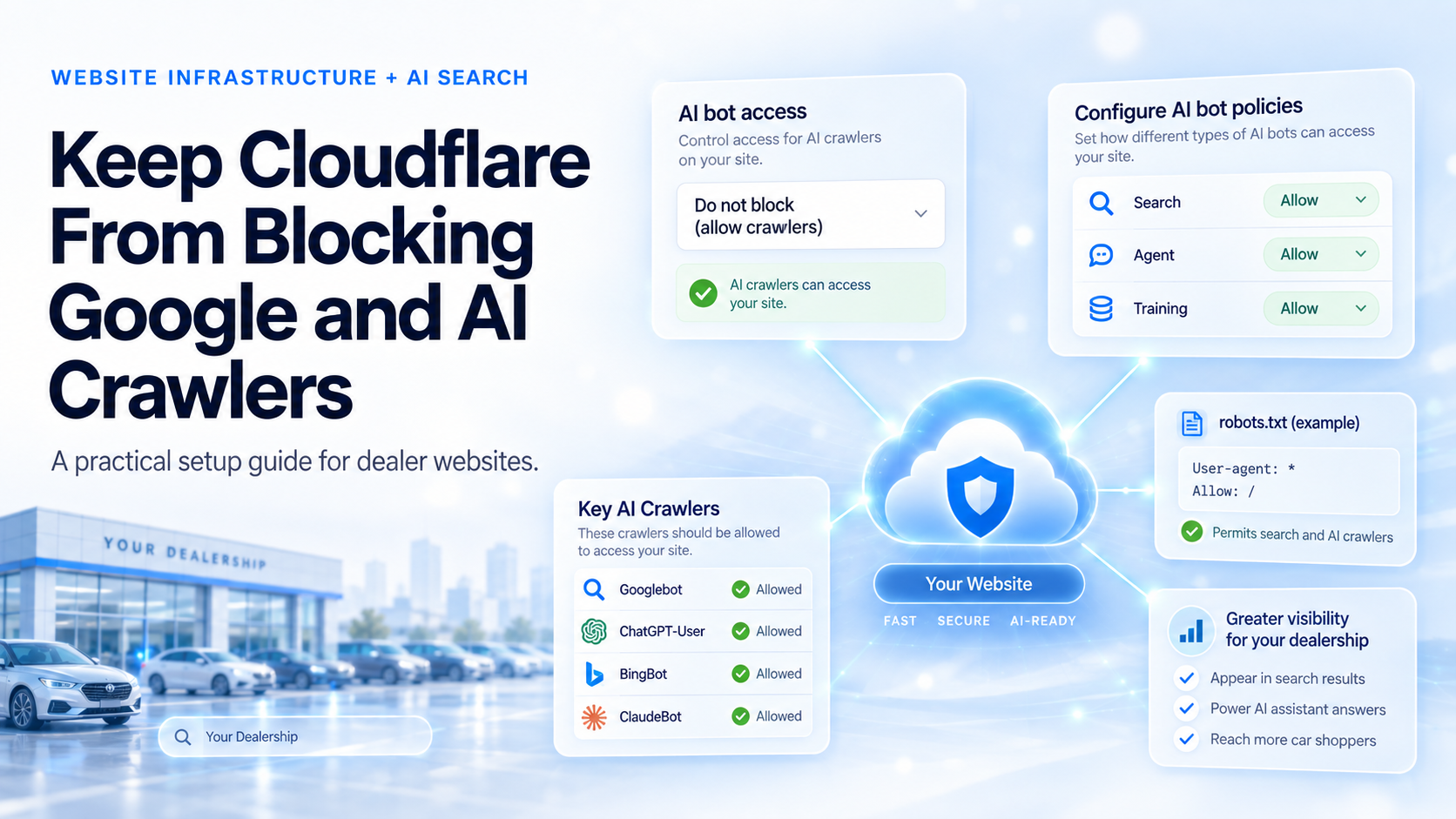
The technical checks run alongside every step; verifying that robots.txt is not blocking AI crawlers takes minutes.

Reputation comes first after measurement because it is the highest-leverage signal and mostly costs attention rather than money. Inventory readability follows because that is where transaction questions land. Content compounds over months, not days.

This is the moment for dealers to take the direct relationship back. AI wants to recommend the store that actually has the car, the price, the people, and the trust to support the purchase. Our job is to make sure that store is yours.

See who AI recommends in your market.

Start with the public reports for your metro, or get the full picture for your own store - visibility, sentiment, and competition across Find, Buy, and Service, with a prioritized action plan.

View the Visibility Reports Get a Custom Report Or get a demo →

Frequently asked questions

Is AI optimization a replacement for SEO?

No. AI assistants perform live web searches as part of building answers, so your site still needs to be discoverable and rank well. AI optimization builds on a solid SEO foundation; it is the next layer, not a substitute for the first one.

Should my dealership try to appear in answers like "What is the best SUV?"

Those research answers are dominated by national editorial brands, and a single store cannot realistically own them. Focus on the transaction questions - which dealer to buy from, where to service - where AI names a handful of specific stores and your effort changes the outcome.

What is an MCP server, in plain terms?

A standard way for AI agents to ask your systems questions directly - "what RAV4s are in stock right now?" - and get live, accurate answers, instead of scraping your web pages. It makes your inventory reliably readable to AI. More detail in our post on what MCP is and why it matters.

How do I find out where my store stands today?

Start with the Dealer AI Visibility Reports for your brand and metro, which show who AI recommends in your market. For store-level detail - visibility, sentiment, and competition across Find, Buy, and Service, plus a prioritized action plan - request a custom report.
More from AI Strategy

AI Optimization for Dealers: What Matters
AI Visibility
July 29, 2026
Corey Lydstone

AI Optimization for Dealers: What Matters

The CarGenius framework for dealer AI visibility: what we measure (visibility, sentiment, and competition across Find, Buy, and Service) and what moves it.

AI Optimization for Dealers: What Matters
AI Visibility
July 29, 2026
Corey Lydstone

Introducing Dealer AI Visibility Reports

Public reports showing which dealerships AI assistants actually recommend, brand by brand and metro by metro - starting with Toyota across the 25 largest US metros.

75%

of car shoppers now start with AI

3.2x

higher conversion with AI search

24/7

instant answers for every shopper

our latest updates

Stay ahead of the curve

Get weekly insights on AI, automotive commerce, and dealer tech delivered to your inbox.

No spam. Unsubscribe anytime.
Thank you!
Something went wrong. Please try again.