
Is AI Visibility Worth Investing In? We're Measuring the Wrong Thing.
BREAKING: Dealership finance departments take credit for 100% of vehicle sales.
"Every deal gets signed here. We've checked the data."
Okay, that's a joke. But we all know the finance office isn't responsible for selling every car just because the paperwork ends up there. Advertising, reviews, salespeople, test drives, and a lot of other things influenced that purchase along the way.
That's what I kept thinking about while reading the latest debate around AI visibility.
Rand Fishkin recently highlighted several studies questioning whether investing in AI visibility is worthwhile, particularly given how little website traffic and measurable business it generates today.
The research is compelling. Marie Haynes analyzed 145 million website sessions and found that ChatGPT generated just 0.62% as much referral traffic as Google organic search. Interestingly, ChatGPT visitors converted at a much higher rate in her dataset, but Google still generated vastly more total conversions.
Kevin Indig went a step further, looking beyond referral traffic to test whether greater AI visibility leads to more branded searches or direct website visits. Across 632 tests involving four brands, he couldn't establish a reliable relationship.
These are legitimate findings from people I respect, and we shouldn't dismiss them. Google still dominates measurable search traffic, and the evidence connecting AI visibility to incremental revenue remains limited.
But I do question what we're concluding from the data.
Are we measuring whether AI influences how consumers research and buy things, or are we primarily measuring whether AI sends people to websites? Those are two very different questions.
The customer journey is changing. Attribution isn't keeping up.
Imagine someone asking ChatGPT which three-row SUV they should buy. It recommends a Toyota Highlander, helps compare trims, and suggests a few nearby dealerships. The consumer then Googles one of those dealerships, checks inventory, and schedules a test drive.
Google Analytics reports an organic visitor. But who influenced the decision?
There's actually some interesting research supporting this behavior.
Similarweb studied consumers who received brand recommendations from ChatGPT across finance, travel, and beauty. Users were 2.5 times more likely to subsequently visit the AI-recommended brand than its competitor within seven days.
Even more interesting, 55.9% of those AI-influenced visits came through search, compared with 40.4% of other visits.
That's not proof that AI generated incremental sales, and it's not specific to automotive. But it provides evidence that an AI recommendation can influence where a consumer goes next without generating a direct AI referral.
And let's not forget Google itself. AI Overviews and AI Mode are increasingly part of the Google experience, and visits from these features can still show up as Google organic traffic in analytics. Google has started addressing this with dedicated generative AI visibility reporting in Search Console, which provides impression data for AI Overviews and AI Mode. That's helpful, although it still doesn't connect an AI recommendation to a sale.
Google is increasingly becoming an AI answer engine, not just a search engine. So how much of what we call organic search is already an AI-influenced experience?
We're already seeing AI do the shopping
At CarGenius, our core business isn't AI visibility tracking. We do that, and I'll get to why, but our primary focus is building infrastructure for a world where AI agents research, shop, and eventually transact on behalf of consumers.
Is that a huge segment of the automotive market today? No. But is it happening? Absolutely.
Across nearly every dealership we work with, we've encountered what appear to be AI agents submitting leads and going back and forth with sales or service departments on behalf of customers.
We're also seeing consumers using AI right inside dealerships, including at the sales desk, to evaluate financing terms, compare offers, and understand $50,000+ vehicle purchase contracts.
How much of that activity shows up as AI referral traffic? Probably very little, if any. An agent communicating with a dealer doesn't necessarily visit the website, and a customer using ChatGPT while sitting in the finance office certainly isn't generating a referral.
We're still early, but broader adoption data suggests this behavior is growing.
Cox Automotive's 2026 AI in Auto Retail Tracker found that 36% of in-market vehicle shoppers already use AI tools for vehicle research, nearly matching the 38% using automotive-specific websites. And 63% say they definitely or probably will use AI during their next vehicle purchase.
Meanwhile, only 29% of dealers have begun adjusting to AI-powered search.
Outside automotive, Meta recently reported that more than 10 million people in the US and Canada had set up its Muse personal agent in just six weeks. About 25% use it daily, and shopping is its most common use case. More than a quarter of people using Muse are engaging in shopping, with an average purchase size exceeding $200.
That's an interesting early signal for agentic commerce. It doesn't mean people are buying cars through agents yet, but consumers are clearly becoming comfortable letting AI do more than simply answer questions.
In automotive, I think the biggest opportunity is transactional intent
Having spent much of my career in automotive marketplaces, I find this shift particularly interesting.
For years, automotive SEO has focused heavily on creating content around make, model, year, and research-related searches. Think "2026 Toyota RAV4 review" or "Honda CR-V vs. Toyota RAV4."
That strategy made sense when consumers needed to click through to websites to get their answers. But why read a generic vehicle review on a dealer's website when AI can synthesize reviews from multiple sources and personalize the answer?
I expect much of this informational search activity to become increasingly zero-click. That doesn't mean traditional SEO is dead, but the economics of generating repetitive content simply to attract visitors are likely to change.
Where things get really interesting is further down the funnel.
Consider someone asking an AI assistant to find a new Toyota RAV4 Hybrid XLE within 30 miles, compare the available vehicles, and recommend the best dealership based on pricing, reputation, and customer experience.
That's a fundamentally different search. The consumer isn't just researching a vehicle. They're ready to shop, and AI is helping determine which dealerships get considered.
In the pre-AI world, marketplaces like Autotrader, Cars.com, and CarGurus captured enormous value by being present at exactly this moment. AI has the potential to become another intermediary, helping consumers compare actual inventory and potentially take action without visiting a marketplace or dealership website.
This is where I think transactional-intent AI visibility becomes particularly valuable.
When AI recommends a vehicle, it can also recommend a dealership, explaining why that store is a good place to buy based on pricing, reviews, transparency, and customer experience.
Getting into that recommendation is potentially much more valuable than appearing in a generic informational answer. And having the infrastructure that allows an AI agent to actually do something with the recommendation is even more interesting.
That's a big part of what we're building at CarGenius. Our MCP infrastructure makes dealership inventory and information accessible to AI agents, and we're expanding what those agents can do, including service scheduling and other dealership interactions.
The goal isn't just to get a dealership mentioned. It's to make sure an AI agent can find the right vehicle, get accurate information, and help the consumer take the next step.
So why do we also track AI visibility?
Because understanding how AI recommends dealerships is an important part of preparing for this shift.
We publish AI Visibility reports across automotive brands and markets, measuring which dealers get recommended, how frequently they appear, and which sources AI relies on.
One objection I hear fairly often is that AI answers are inconsistent, so measuring visibility doesn't mean anything. There's truth to the concern, but I think it misses the point. You don't measure AI visibility by asking one question once and declaring a permanent winner. You measure a distribution of answers across consistent shopping queries, models, and markets.
In our initial Toyota analysis of Miami, AI assistants named dealerships in 99.6% of responses, typically recommending just three to six stores. That's a pretty narrow consideration set in a competitive market.
And can you actually improve your positioning?
We're starting to see encouraging evidence.
One automotive dealer group recently conducted its own analysis using a third-party AI visibility measurement tool. They normalized expected AI visibility based on online reputation, which had the strongest correlation with visibility in their analysis, and compared stores using different AI optimization solutions.
The two dealerships using CarGenius showed approximately 15% stronger AI visibility performance than stores without our product, after adjusting for reputation.
It's a small sample, not a controlled experiment, and it doesn't prove causation or increased vehicle sales. But the analysis was conducted by the dealer group using a tool we don't control, and the findings were encouraging enough that they decided to expand CarGenius across their stores.
I think that's the right approach. Measure where you stand, make improvements, and keep working to connect those improvements to business outcomes.
Importantly, many of the things that should help AI recommend a dealership are simply good business practices: accurate inventory, transparent pricing, clear buying and service processes, and a strong reputation across Google and third-party review sites.
These aren't tricks to game an algorithm. They're investments that can also benefit traditional SEO, customer experience, and ultimately the dealership's business.
Google is still king. But when does that change?
I'm certainly not suggesting dealers abandon Google, traditional SEO, or any marketing channel generating measurable results today.
And if someone is promising a flood of ChatGPT leads next quarter simply by optimizing a few pages for AI citations, I'd be skeptical.
But I also wouldn't assume today's referral traffic tells us where automotive shopping will be three or five years from now.
The question I keep coming back to is when this tips. When does AI become a major source of vehicle discovery, dealership selection, and eventually transactions? And if you wait until the revenue is obvious in your attribution reports, are you already behind?
Nobody knows the exact timing. But building clean data infrastructure, making inventory accessible to agents, developing integrations with dealership systems, and improving how AI understands your business aren't things that happen overnight.
If I were running a dealership today, I'd keep investing in traditional SEO, but I'd also start measuring AI visibility for real shopping queries, make sure my inventory and reputation information are accurate and accessible, and begin asking customers how they discovered the dealership. I'd want to know whether AI helped them choose a vehicle, find our store, or prepare for their purchase, and I'd start connecting those answers to actual leads and sales.
And I'd be thinking seriously about how AI agents will interact with my dealership as they become more capable.
We absolutely need better research connecting AI recommendations to incremental revenue. The recent studies are useful, and challenging the hype around GEO is healthy for the industry.
But don't confuse a lack of referral clicks with a lack of commercial activity.
The next generation of automotive commerce may be less about getting a consumer to visit your website and more about making sure their AI agent can find your dealership, recommend it, and do business with you.
That's the opportunity I'm focused on, and I think it's worth preparing for today.
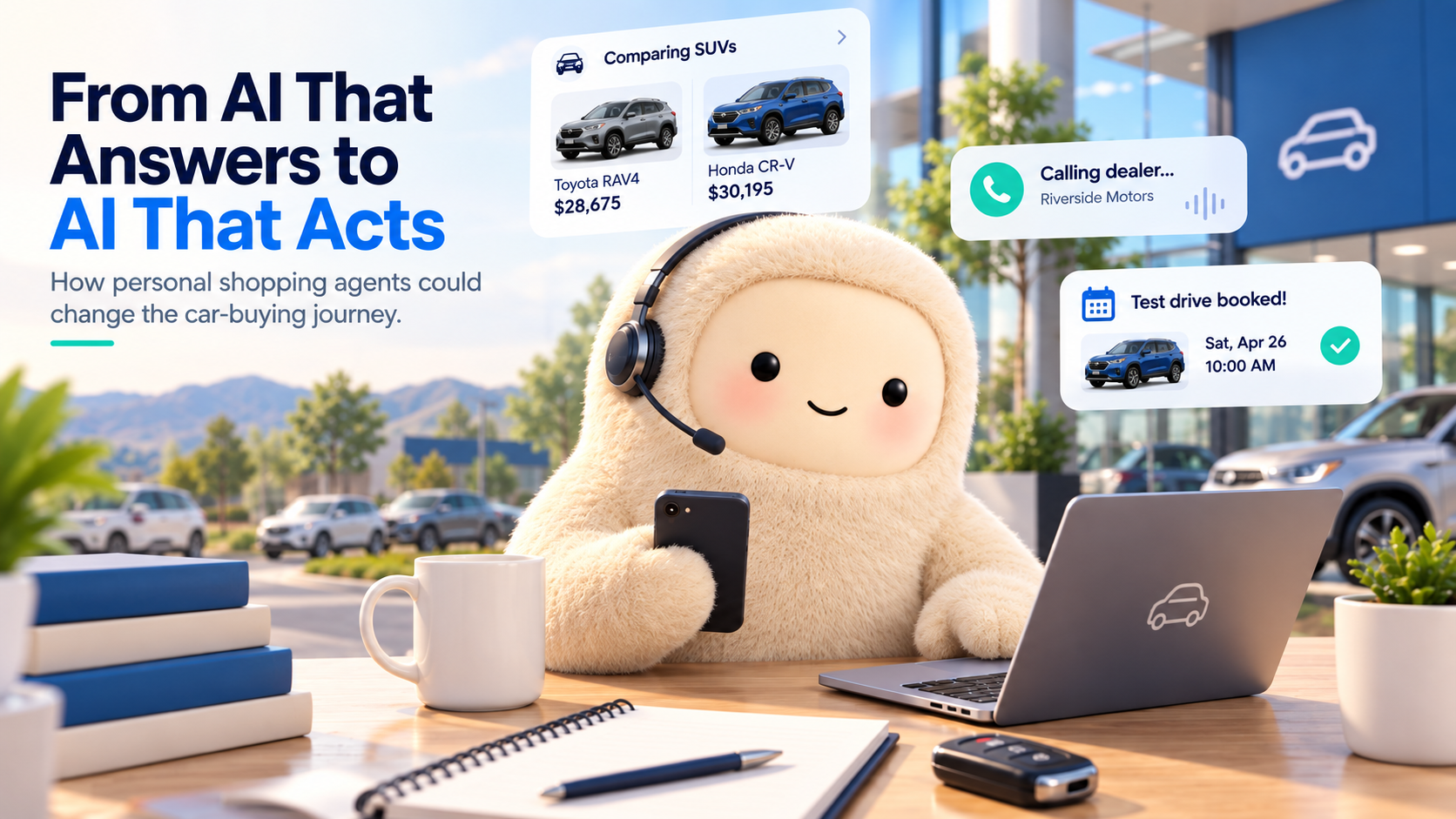
Meta Muse: From AI that answers to AI that acts
Meta's new personal AI agent, Muse, takes on tasks instead of answering questions. We gave it a dealership MCP server: it searched live inventory and submitted a lead. What that means for dealers when the next shopper is an agent.

Dealer AI Visibility Trends: September 2026
What changed from August to September in terms of dealer AI visibility, and how dealerships can respond.
of car shoppers now start with AI
higher conversion with AI search
instant answers for every shopper
Stay ahead of the curve
Get weekly insights on AI, automotive commerce, and dealer tech delivered to your inbox.