
AI Search is not another chat widget
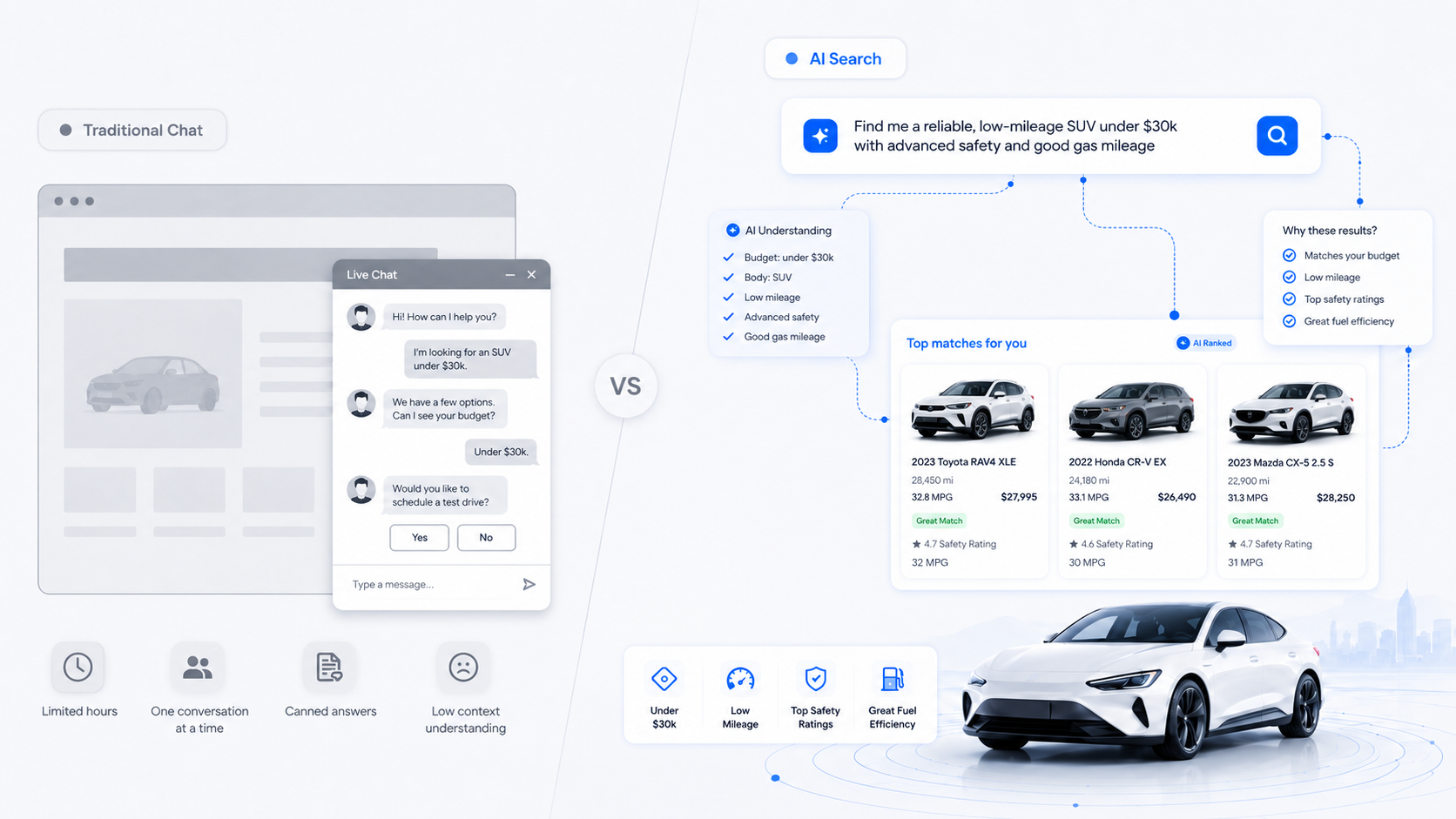
AI Search is not another chat widget
When we talk to dealers about deploying AI Search on their sites, we often get compared to traditional chat.
We think that is a mistake.
I understand why the comparison happens. AI Search shows up on the website. A shopper can type into it. It answers questions. It can generate a lead. So, sure, it looks like chat.
But the job is different. Traditional chat is built around lead capture. AI Search is built around answering the shopper's question.
That sounds like a small difference. It is not. It changes the entire experience.
The problem with traditional chat
Most dealer websites already have some form of chat. Sometimes it is managed chat. Sometimes it is a BDC tool. Sometimes a bot pretending to be more helpful than it is.
There is a place for that. A shopper who wants to schedule a test drive or talk to a person should be able to do that quickly.
But let's be honest about how most chat works today. A shopper asks a real question. "Does this car have the luxury package?" "Is this good for a new driver?" "Can I buy from out of state?"
And too often, the answer is some version of: "Great question. Can I get your name, email, and phone number?"
That is not an answer. That is a gate.
It is the same problem dealers have had on their websites for years. The site is full of inventory, buttons, forms, and popups, but the shopper still has to do most of the work. They have to search, filter, compare, understand trim differences, open five VDPs, decode vehicle history, and decide whether a car is actually right for them. And if they ask for help, they get pushed into a lead workflow before they get a useful answer.
That is not how people are learning to use AI.
Inside ChatGPT, Claude, and Gemini, shoppers are learning that they can ask a complete question in normal language and get a useful answer back. They do not want to guess the right filter or click through 120 results. They want to ask, "I need a reliable used SUV for my son under $30,000 with AWD," and have the system understand what they mean.
That is the shift.
AI Search starts with the question
AI Search is built for that new behavior.
A shopper does not have to know the exact make, model, trim, or drivetrain. They can just ask the way they would ask a salesperson. "I need something safe for my teenager." "I want a three-row SUV, but nothing huge." "I need a truck that can tow a small boat."
A traditional site search sees keywords. AI Search sees intent.
If the question is too broad, it asks a follow-up. If the shopper says "SUV for my son," it should not dump every SUV on the lot into a results page. It should ask about budget, mileage, AWD, and what matters most. Then it can search the actual inventory, return the best matches, explain why they fit, and link directly to the dealer's VDPs.
That is a very different interaction. It is not "here are 73 results, good luck." It is closer to: "Based on what you said, I would start with these three. This one is the best value, this one is newer with lower miles, and this one gives you more space but costs a little more."
It narrows. It explains. It helps the shopper make progress.
The dealership matters too
Inventory is only part of the answer.
A great salesperson does not just know the cars. They know the store. They know the buying process, whether the dealership works with out-of-state buyers, how deposits work, the doc fee, whether service is open on Saturday, what languages the team speaks, and why a customer should buy this car from this store.
Most websites do not make that easy. Some of that information is buried. Some is inconsistent. Some lives on pages copied from a template years ago and never updated. Some lives only in the heads of the best people at the store.
When we connect AI Search to a dealer's MCP server, we are not just giving the shopper a better search box. We are giving the AI access to the dealership's actual inventory, content, policies, and workflows. The shopper can ask about the car, ask about the store, ask about the process, and when they are ready, take the next step.
That is what the website should have been doing all along.
It is powered by MCP
AI Search is not a standalone bot trying to memorize your website. It is the first live application of the dealer's MCP server.
The MCP server gives the AI tools. It can search inventory, pull VIN-level details, understand dealership information, and help submit a lead into CRM workflows. That matters because the answer is grounded in real data.
The AI is not guessing whether a vehicle exists. It is using a tool to search inventory. It is not inventing a VDP link. It is pulling the direct link from the dealer's data. It is not relying on stale marketplace pages. It is connected to the dealer's own source of truth.
That is the difference between a chatbot and an AI-native shopping experience. A chatbot talks. AI Search does work.
It still drives leads
This is not anti-lead. Dealers need opportunities. Shoppers still need to raise their hand. The difference is when and how it happens.
AI Search earns the lead by being useful first. Answer the question. Explain the tradeoffs. Give the shopper confidence. Then, when they are ready, make the next step easy. "Do you want to schedule a test drive?" "Should I have the team follow up?"
That creates a better lead, because now the shopper is not just a name and email attached to a vague VDP view. The dealer can see what they asked, what they cared about, what vehicles they considered, and where they were in the decision. That is context, and context makes follow-up better.
It can work alongside live chat
AI Search does not have to replace every existing chat tool on day one. Some dealers want it to coexist with their current chat provider, in a different position or as a full-page assistant. Other dealers look at it and say, "This is better than what I am paying for today. I want this to replace chat." Both can work. The right answer depends on the dealership.
There are times when a human handoff makes sense. A shopper wants to negotiate, or needs help with a complicated trade, or wants a specific appointment time. Route them. But the first layer of interaction should not require a person to answer basic questions that AI can answer instantly and consistently.
The best version is not AI instead of humans. It is AI handling what AI is good at, and humans stepping in where humans matter most.
It is also a learning system for the dealer
Here is the part that is not obvious at first. Dealers get to see how AI understands their store.
Most dealers have no idea what shoppers are asking ChatGPT. They do not see those conversations, and they do not know what information is missing. AI Search changes that. You can see the questions shoppers ask on your site, how the AI answers, and where it gets confused.
And when something is wrong, it usually tells you something important. Maybe your website says you have a finance department, but your actual process is one person, no office, no games. The AI is not wrong because it is dumb. It is wrong because your website told it the wrong story. Maybe your service page is missing details. Maybe your sitemap does not expose important pages. Maybe your reconditioning work is invisible. Maybe your doc fee is not clearly disclosed.
AI Search surfaces those gaps. And fixing them does not just improve the on-site assistant. It improves the dealership's AI-facing infrastructure.
That is the flywheel. Better data improves AI Search. Better AI Search reveals better insights. Better insights improve the MCP server. And a better MCP server prepares the dealership for the moment outside AI agents come shopping directly.
Some dealers are already going further
The dealers who use AI Search tend to get it quickly. And a few have pushed it further than we expected, which is rethinking the website itself.
For years, the path has been the same. Home page to search results to vehicle detail page to lead form. A fixed funnel the shopper has to walk through in order.
For some of our dealers, we are now deploying something different: a standalone, AI-first website experience, where the shopper does everything inside AI Search. No rigid path from page to page. The shopper asks, explores, compares, and acts in one place, in whatever order makes sense to them.
We could build that quickly because the MCP server was already in place. The inventory search, the vehicle details, the dealership information, the lead tools, all of it was already there. Standing up an AI-first experience on top of it was fast, because the hard part, the infrastructure, was done.
That is the whole point of building on MCP. The car is still the car. The store is still the store. But the structure becomes the conversation, not the click path. And a non-linear, AI-first experience only works if the AI has real tools and real data underneath it. That is exactly what the MCP server provides.
We think that is where this goes.
The dealer website needs a new front door
For years, the front door to the dealer website was search. Search by make, model, price, payment, body style. That still matters.
But AI creates a new front door. Ask. Ask what fits your life. Ask what is available. Ask what is different. Ask what the store can do. Ask what happens next.
That is how more shoppers are going to navigate the web, and dealer websites need to support it. Not with another popup that tries to capture a lead before answering the question. With AI Search that actually helps.
The dealer website is not going away. But the way shoppers use it is changing. The winners will be the dealers who answer first, earn trust, and make the next step easy.
That is what we are building at CarGenius. AI Search is not another chat widget. It is the first AI-native shopping experience for the dealer website, powered by the same MCP infrastructure that will help dealers show up directly when AI agents come shopping.

Dealer AI Visibility Trends: September 2026
What changed from August to September in terms of dealer AI visibility, and how dealerships can respond.

ChatGPT Is Asking Car Shoppers More Questions. Here's Why Dealers Should Care.
New CarGenius data shows a sudden rise in follow-up questions about vehicles, budgets and service needs, adding another step to how shoppers find dealerships.
of car shoppers now start with AI
higher conversion with AI search
instant answers for every shopper
Stay ahead of the curve
Get weekly insights on AI, automotive commerce, and dealer tech delivered to your inbox.