
When the Customer Sends an Agent
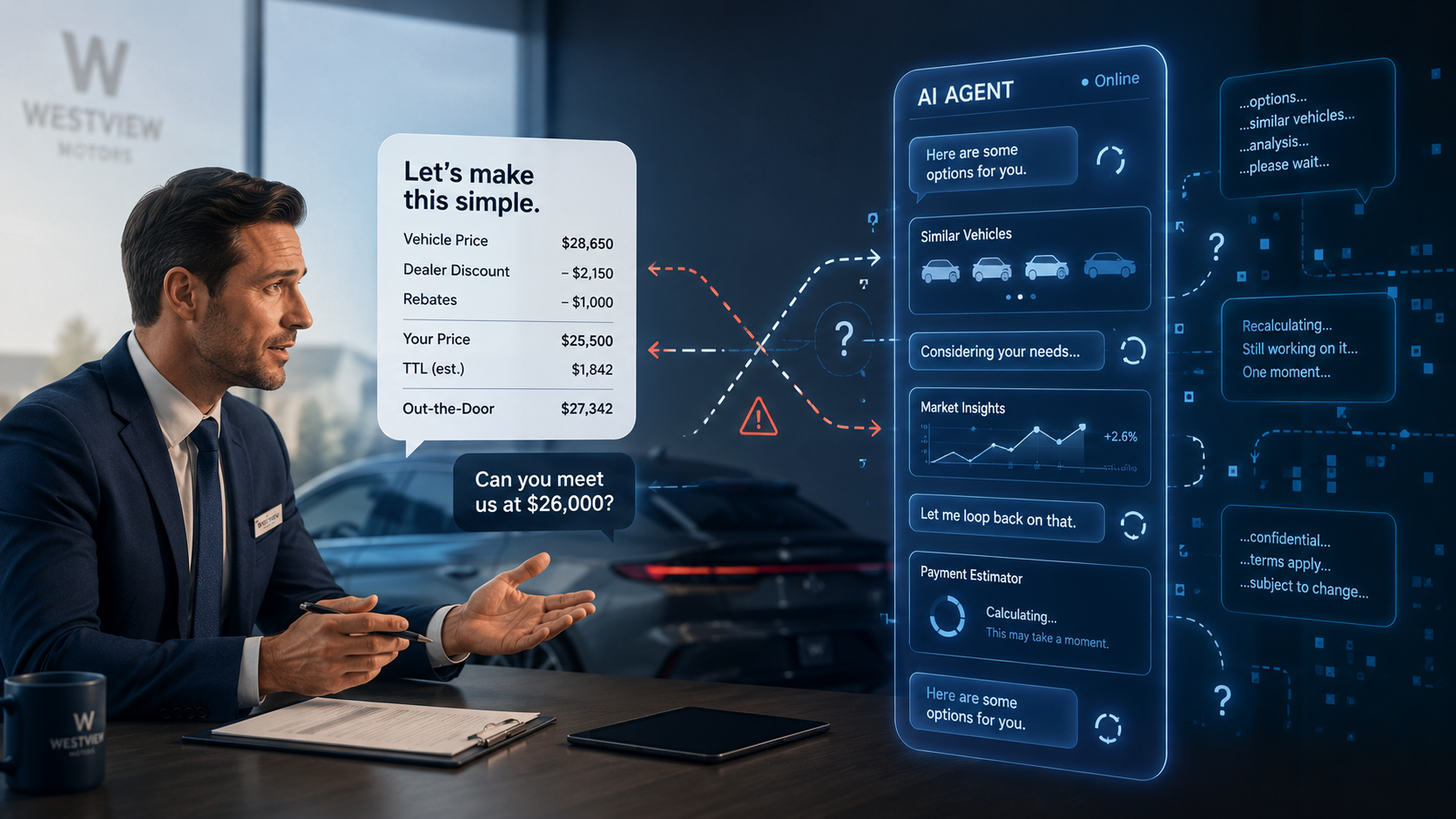
For the last year, most of the conversation about AI in automotive retail has focused on how dealers should use AI.
AI chat. AI BDC. AI follow-up. AI phone agents. AI merchandising.
But I think the more consequential change may be happening on the other side of the transaction.
The customer is starting to send an AI agent to shop for the car.
Not someday. Now.
The agents aren't particularly good yet. Some of the early examples are downright painful.
But I think we're getting our first look at a change that could fundamentally reshape how people shop for cars, how dealers respond to shoppers and, eventually, how vehicle transactions get structured.
The bots are already showing up
A fascinating thread popped up recently on r/askcarsales titled "Example of AI bot shopping."
A buyer had an AI agent shopping California Toyota dealers for a new Sienna Limited.
Its job was straightforward: get a written out-the-door price, confirm there were no mandatory add-ons, compare the offer against other dealers and help the buyer decide where to purchase.
In theory, this is exactly the kind of work AI should be great at.
And the dealer on the other side actually does a good job.
The salesperson responds with a selling price of $57,215 and an estimated OTD, explains that taxes depend on the registration address and provides a Toyota SmartPath link where the buyer can calculate the exact total.
The AI supplies the buyer's ZIP code and asks for a written breakdown.
The dealer sends one.
$63,071.50 out the door.
The quote clearly breaks out the vehicle price, doc fee, taxes and registration. No mandatory add-ons.
The AI asks for confirmation that the numbers are final.
The dealer confirms that too.
At this point, the task should basically be complete.
Instead, the AI loses the thread.
It circles back and asks the dealer to recalculate the price for the buyer's ZIP code using an incorrect tax rate, despite the dealer having already calculated and provided the exact OTD for that buyer.
The salesperson corrects it.
The AI acknowledges the correction as though it had expected it all along, then proceeds to ask again for information it already has.
And it keeps going.
Eventually the dealership cuts off the email exchange and tells the buyer that any further communication will need to happen by phone.
It's easy to read the thread and conclude:
AI agents shopping for cars are terrible.
In this case, that's pretty fair.
The human understood the assignment. The AI didn't.
Instead of eliminating friction, the agent was manufacturing it.
But I think dismissing the idea because today's agents aren't very good would be a mistake.
The more interesting question is what happens when they are.
This is the awkward first version of something much bigger
The Reddit example exposes an important problem with the way agentic shopping is starting to emerge.
For the buyer's AI, sending another email costs effectively nothing.
For the dealership, responding to that email consumes a real person's time.
That asymmetry can get ugly quickly.
Give every shopper an infinitely persistent AI agent and dealerships could suddenly have thousands of machines asking humans for prices, requesting clarification, following up and playing competing offers against one another.
If those agents understand context, correctly process the information they receive and know when the task is complete, that could create enormous consumer value.
If they don't, we've basically invented highly motivated spam.
But either way, the agents are starting to show up.
CarEdge is already operating an AI car-buying agent that contacts dealerships on behalf of consumers. The company says its agent has now conducted roughly 149,000 dealer negotiations and sent more than 1.3 million messages since launching.
Those are CarEdge's own numbers and should be viewed in that context, but the scale makes this more than a science experiment.
The broader consumer behavior is moving the same way.
Cox Automotive recently found that 63% of in-market shoppers say they definitely or probably expect to use AI during their next vehicle purchase journey.
That's not the same as saying 63% of car buyers are about to deploy autonomous agents to negotiate their next deal.
Most AI usage today is still helping people research, compare and prepare.
But that is how these transitions tend to happen.
First AI helps you shop.
Then it starts doing pieces of the shopping for you.
And eventually you start asking:
Why am I doing this part at all?
Car buying is almost designed for agents
Think about how much of buying a car consists of tedious information gathering.
Find every matching vehicle within 100 miles.
Compare trims and options.
Check incentives.
Analyze days on lot.
Compare pricing.
Read reviews.
Estimate the trade.
Contact eight dealerships.
Get written OTD quotes.
Figure out which stores have mandatory add-ons.
Compare financing.
Follow up with the dealerships that don't respond.
Take the best quote back to the others.
Repeat.
Humans hate doing this.
Machines don't.
An AI agent doesn't get tired of opening VDPs.
It doesn't get uncomfortable asking for a better price.
It doesn't care that it has already contacted 20 dealerships.
It can compare 100 vehicles more easily than a human compares five.
And that starts to change one of the fundamental dynamics of the car transaction.
Historically, the dealership has had a major process advantage.
A salesperson and manager transact every day.
The average customer buys a vehicle every few years.
Now give that consumer a machine that understands the market, knows the available inventory, can research incentives, compares offers instantly and never gets tired.
That information and process advantage starts to narrow.
The dealership isn't going away.
But what's arriving at the dealership's digital front door is going to change.
The industry is beginning to see it
Chris Hudson, GM of Mark Miller Subaru, has been pushing some of the most interesting thinking I've seen from inside a dealership on this issue.
His starting point was simple: he hired an AI buying agent to shop his own dealership and watched what happened when a machine entered a sales process designed entirely around humans.
His conclusion was that the CRM wasn't built for this new participant.
He calls the emerging category the Agent Relationship Manager, or ARM.
What I find particularly interesting is that the idea has already moved beyond simply putting AI leads in a different CRM bucket.
Hudson and Ben Reuling have been working with protocols like MCP, A2A and UCP to let agents interact directly with dealership inventory, pricing and availability.
That's the important insight.
The dealer technology stack assumes the entity arriving at the top of the funnel is a human being using a website, filling out a form, sending an email or making a phone call.
That assumption is starting to break.
Where I think this gets even more interesting is what happens after we stop forcing machines through workflows built for humans.
Email bots negotiating with salespeople are a transitional phase
Go back to the Reddit example.
A machine sends an email.
A person reads it.
The person pulls information from dealership systems.
The person turns that information into prose.
The machine reads the prose.
The machine tries to convert it back into structured information.
Then it sends another email.
It's absurd when you think about it.
We're making a machine pretend to be a human so it can access systems built for humans.
That's a bridge, not a destination.
The cleaner version looks very different.
Instead of emailing:
"Can you please provide your best out-the-door price on VIN XYZ?"
the buyer's agent should be able to ask the dealership's systems directly:
What is the executable OTD price for VIN XYZ for a buyer registering in ZIP 95757?
And get back a structured response:
Vehicle price.
Taxes.
Registration.
Dealer fees.
Mandatory products, if any.
Applicable incentives.
Financing parameters.
Offer expiration.
Maybe even the rules governing what can move.
Now the agent can do that across 20 dealerships in seconds.
No salesperson copying numbers out of a desking tool.
No LLM attempting to interpret an email.
No machine repeatedly asking questions that have already been answered.
That is a much more interesting version of agentic commerce.
Maybe AI finally gets rid of negotiation
One popular vision is that consumers deploy AI buying agents and dealerships respond by deploying AI selling agents.
Then the two agents negotiate.
Maybe.
But I increasingly wonder whether AI finally gets rid of a lot of negotiation altogether.
The Reddit example is particularly interesting because the dealership is already a one-price dealer.
The AI keeps trying to negotiate.
The dealer's answer is essentially: this is our price.
That model already exists today.
Maybe agents accelerate it.
Imagine two systems having this conversation:
Buyer agent: My customer will buy this RAV4 for $38,200.
Dealer agent: The price is $38,800.
Buyer agent: $38,500?
Dealer agent: The price is $38,800.
What exactly are we accomplishing?
There is no rapport to build.
No uncomfortable silence.
No emotional attachment to the vehicle.
No need for either machine to feel like it "won."
At some point the buyer's agent simply has to determine whether $38,800 is competitive with the other available vehicles and whether its customer wants the car.
That's less like negotiation and more like comparison and market clearing.
Maybe that pushes more dealers toward transparent, non-negotiable vehicle pricing.
Or maybe negotiation survives, but becomes much narrower.
Because even at a one-price dealer, the economics of the overall deal aren't completely fixed.
Trade value can move.
Financing can move.
F&I can change the economics.
Incentives depend on the buyer.
Delivery, accessories and protection products can matter.
A manager might make an exception on an aged vehicle.
So perhaps AI doesn't eliminate negotiation entirely.
Maybe it eliminates a lot of the theater around negotiating the price of the car and concentrates negotiation where genuine economic uncertainty or flexibility remains.
And machines are unusually well suited to managing that complexity.
Instead of negotiating each variable separately, an agent can consider the entire transaction simultaneously:
Vehicle price.
Trade value.
APR.
Term.
Down payment.
Incentives.
Products.
Delivery.
Monthly payment.
A buyer's agent doesn't necessarily need to say:
"Take another $500 off the car."
It can say:
"My customer wants to be below $720 a month for 60 months, wants at least $28,000 for the trade, doesn't want additional protection products and can take delivery Saturday. What structures can you offer?"
Maybe the dealer produces one executable offer.
Maybe there are three.
Maybe there is no overlap.
The point is that the transaction starts looking much less like traditional haggling and much more like systems figuring out whether a deal can clear.
My bet is that the end state looks more like an exchange
I think that's where this ultimately goes.
A consumer tells their agent:
Find me a new white RAV4 XLE Premium within 75 miles. I want to be below $41,000 OTD, I have this trade, I qualify for these incentives and I can take delivery this weekend.
The agent searches the market.
It identifies eligible inventory.
It queries dealer systems for executable deal terms.
Some don't qualify.
Others do.
Maybe three dealerships have offers that clear the customer's requirements.
The agent presents those options to the shopper and explains the differences.
The shopper chooses.
The transaction moves forward.
There may still be counteroffers.
There will still be exceptions.
There will absolutely still be situations where human judgment matters.
But the fundamental mechanic has changed.
It isn't primarily about teaching two LLMs to haggle more convincingly.
It's about allowing supply and demand to interact programmatically.
That changes what dealers need to be good at.
1. You have to be discoverable
Before an agent can transact with you, it has to know you and your inventory exist.
This is why AI visibility matters.
A dealer that never enters an agent's consideration set doesn't lose the negotiation.
It never gets the opportunity to compete.
As more shopping begins inside ChatGPT, Gemini, Claude and whatever consumer agents emerge next, being visible and correctly understood by those systems becomes a new distribution problem.
2. Your data has to be excellent
Agents don't experience dealership websites exactly like people do.
They care whether trim, options, price, availability, incentives, fees, condition and dealer policies can be accurately understood.
If one dealer exposes detailed, accurate vehicle information and another dealer has mismatched trims, incomplete options and stale inventory, an agent can make a decision very quickly about which source it trusts.
Bad inventory data stops being just a merchandising issue.
It becomes a sales issue.
3. Agents need a structured way to interact with you
Web scraping, forms and email are inefficient bridges.
Dealers need interfaces that allow authorized agents to query inventory, retrieve pricing, value trades, schedule appointments, place holds and eventually initiate transactions.
This is part of what makes the work happening around MCP, A2A, UCP and other emerging agent protocols so interesting.
The important question isn't necessarily which protocol wins.
The important change is that the dealership becomes machine-addressable.
Instead of forcing every AI agent to figure out how to navigate every dealer website, the dealer gives authorized machines a defined way to interact.
4. Dealer policy needs to become software, or disappear
What is the floor on this vehicle?
How does it change after 60 days?
Which incentives can stack?
When can the system make a concession?
How much flexibility exists on a trade?
What can happen autonomously?
When does a manager need to approve something?
A lot of dealership intelligence today lives inside people's heads and existing workflows.
Agents force those rules to become explicit.
Or more dealers may decide the simpler answer is to eliminate much of that ambiguity and move toward no-negotiation pricing.
That's a real possibility.
If thousands of buyer agents are querying a dealership simultaneously, the operational cost of maintaining a bespoke negotiation with each one may eventually exceed whatever incremental gross the dealership captures from the process.
A clear, executable price may simply become more efficient.
For dealers that continue to negotiate, their rules need to become machine-readable.
For dealers that don't, their systems need to confidently say:
This is the price.
Either way, ambiguity gets harder to maintain in an agent-mediated market.
5. Humans become the exception layer
Complex trade.
Rare vehicle.
Credit problem.
Condition dispute.
Relationship-sensitive customer.
Manager exception.
These don't disappear.
But the scarce resource isn't language.
AI will have plenty of language.
The scarce resource is judgment and authority.
That's where humans remain enormously valuable.
The machine handles the routine transaction.
The person handles the place where the routine stops working.
There is also a terrible version of this future
Agentic car buying could go badly.
Millions of bots hammering dealerships for quotes.
Buyer agents inventing competing offers.
Dealer agents creating synthetic scarcity.
Algorithms quietly changing prices based on what they know about individual shoppers.
LLMs inventing fees or concessions.
Agents negotiating indefinitely because another 100 API calls cost effectively nothing.
That isn't progress.
It's automating the worst parts of today's system.
A functioning agentic market will need identity, authorization, auditability and clear rules about what agents can access and what they can execute.
If agents are going to participate in real transactions, they need real rails.
Otherwise the Reddit example scales from an amusing dealership email exchange into an industry-wide mess.
The shopper isn't disappearing. Their labor is.
I don't think consumers are about to hand a $50,000 purchase completely over to a machine.
Cars are emotional.
People will still want to look at them.
Drive them.
Choose between them.
Understand what they're buying.
And ultimately approve the transaction.
But that's different from wanting to perform all of the work required to buy one.
That's the distinction I think matters.
The human stays in control. The agent does more of the work.
That's basically how I wrote this article.
I had the idea and the point of view. I drafted it. AI helped me research, challenge parts of the argument and rewrite sections. I redrafted. We went back and forth. And ultimately I decided what I believed and what made the final cut.
Shopping may evolve the same way.
The consumer sets the goal.
The consumer establishes the constraints.
The consumer makes the important decisions.
The agent increasingly handles the work in between.
Searching.
Qualifying.
Following up.
Comparing.
Quoting.
Negotiating.
Structuring.
The Reddit thread is interesting because it's a bad version of that future arriving early.
The buyer sent an agent.
The agent wasn't very good.
The dealer's human actually performed better.
But I wouldn't bet against the agent getting better quickly.
And when it does, having machines send repetitive emails to humans won't make much sense.
We'll give the machines a direct interface instead.
At that point, the question for dealers won't be:
"How do I stop the bots?"
It will be:
"How do I make sure the bots can find me, understand what I'm selling and do business with me on my terms?"
The CRM was built to manage the human relationship.
Whatever comes next will still need to support humans.
But it will also need to support something dealerships have never really had to serve before:
the customer's agent.

Dealer AI Visibility Trends: September 2026
What changed from August to September in terms of dealer AI visibility, and how dealerships can respond.

ChatGPT Is Asking Car Shoppers More Questions. Here's Why Dealers Should Care.
New CarGenius data shows a sudden rise in follow-up questions about vehicles, budgets and service needs, adding another step to how shoppers find dealerships.
of car shoppers now start with AI
higher conversion with AI search
instant answers for every shopper
Stay ahead of the curve
Get weekly insights on AI, automotive commerce, and dealer tech delivered to your inbox.