
Why Yelp Matters for Car Dealers in AI Search
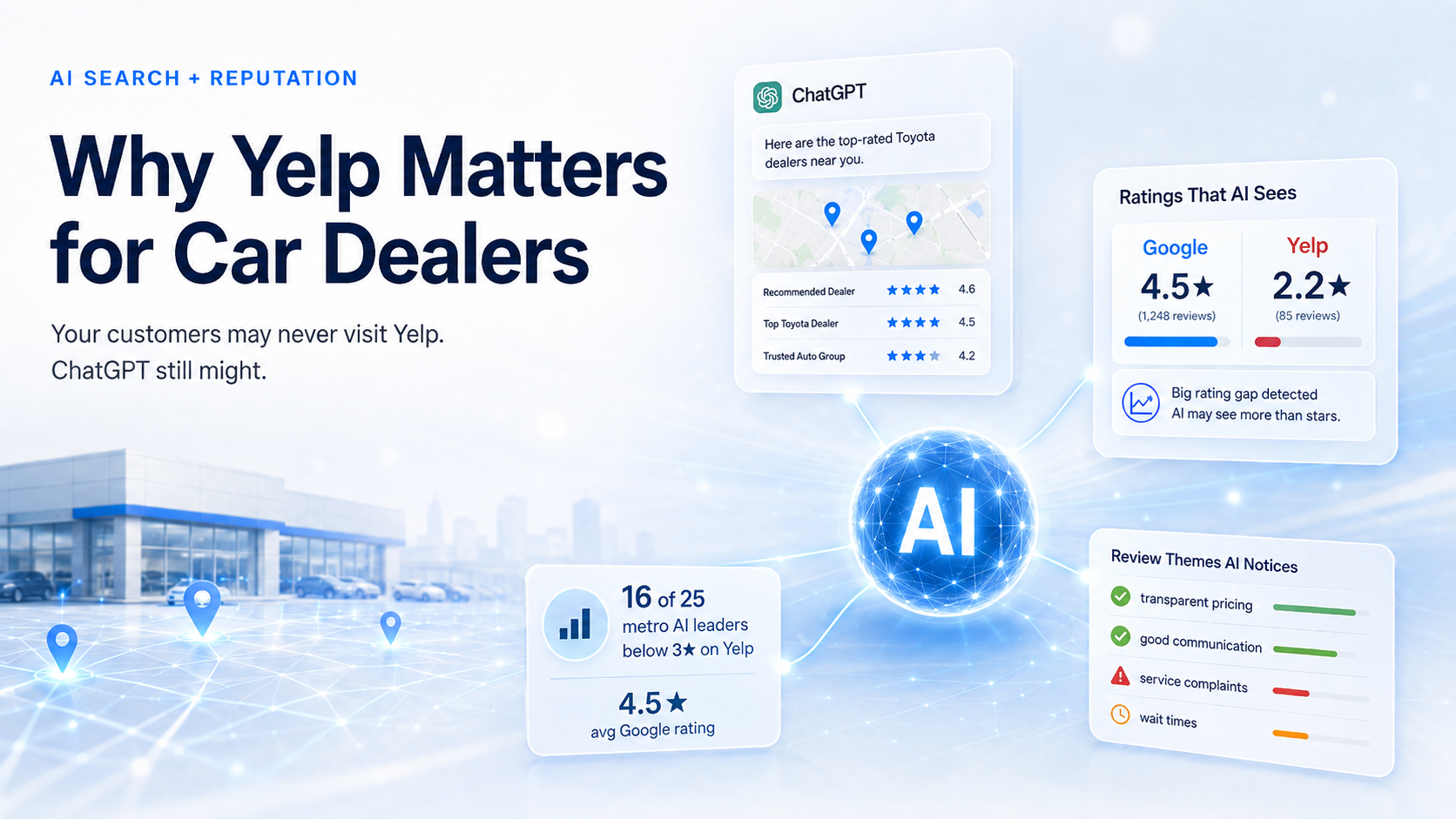
For years, many car dealers had good reasons to put Yelp low on the priority list.
Google reviews mattered more. Automotive sites such as DealerRater and Cars.com were closer to the shopping process. Yelp ratings were often noticeably lower, service complaints were common, and many dealers questioned whether the platform was worth the effort.
AI search changes that calculation.
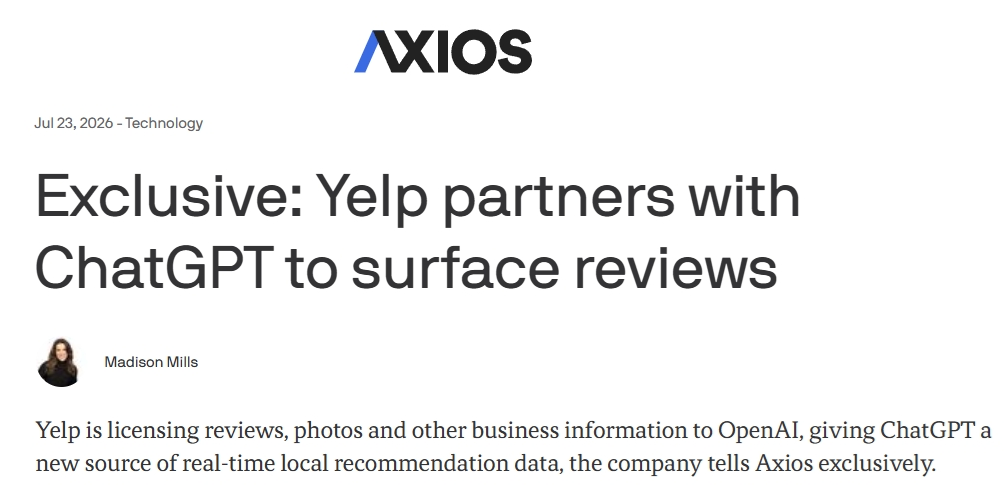
Yelp is already routinely cited by ChatGPT for car dealerships and a recent licensing relationship between OpenAI and Yelp that provides access to Yelp reviews, ratings, photos, and business information for local-business answers may make Yelp citations even more frequent.
And there is another reason dealers should pay attention: CarGenius data shows that Yelp is already a major reputation weak spot for many dealerships that AI recommends.
For dealers, the takeaway is not “go buy Yelp ads” or “get to five stars on Yelp.” It is to understand what Yelp says about your store, because that information can now travel into AI-powered local discovery.

AI search changes how customers find and rate dealerships
Traditional search usually leaves the comparison to the shopper. Someone searches Google for “Toyota dealer near me,” gets a map and a list of stores, then decides what deserves a click.
AI search can move that decision earlier. A shopper can ask, “Where should I buy a three-row SUV if I want transparent pricing and don’t like high-pressure sales?”
Now the shopper is not asking for ten blue links. They are asking for a recommendation.
Car buyers are already experimenting with this behavior. Cox Automotive found that 19% of all vehicle buyers and 25% of new-vehicle buyers used AI websites or AI-generated search results during the 2025 vehicle-shopping process.
What changed between Yelp and OpenAI
Yelp first disclosed an agreement with OpenAI in February 2026. In July, the companies provided a much clearer picture of the relationship.
Yelp is licensing reviews, ratings, photos, and other business information to OpenAI so ChatGPT can use that information in local-business responses. Yelp branding and links can appear when its content is used, although OpenAI controls how the final experience is presented.
That last detail matters.
A dealer should not assume that every star rating shown inside ChatGPT comes from Yelp. But the opposite assumption is risky too. If you do not see a Yelp logo or citation, that does not prove Yelp played no role in the broader answer.
CarGenius data shows just how different Yelp can look
The difference between dealership ratings on Google and Yelp is not just something dealers complain about. We see it in our own AI visibility measurement.
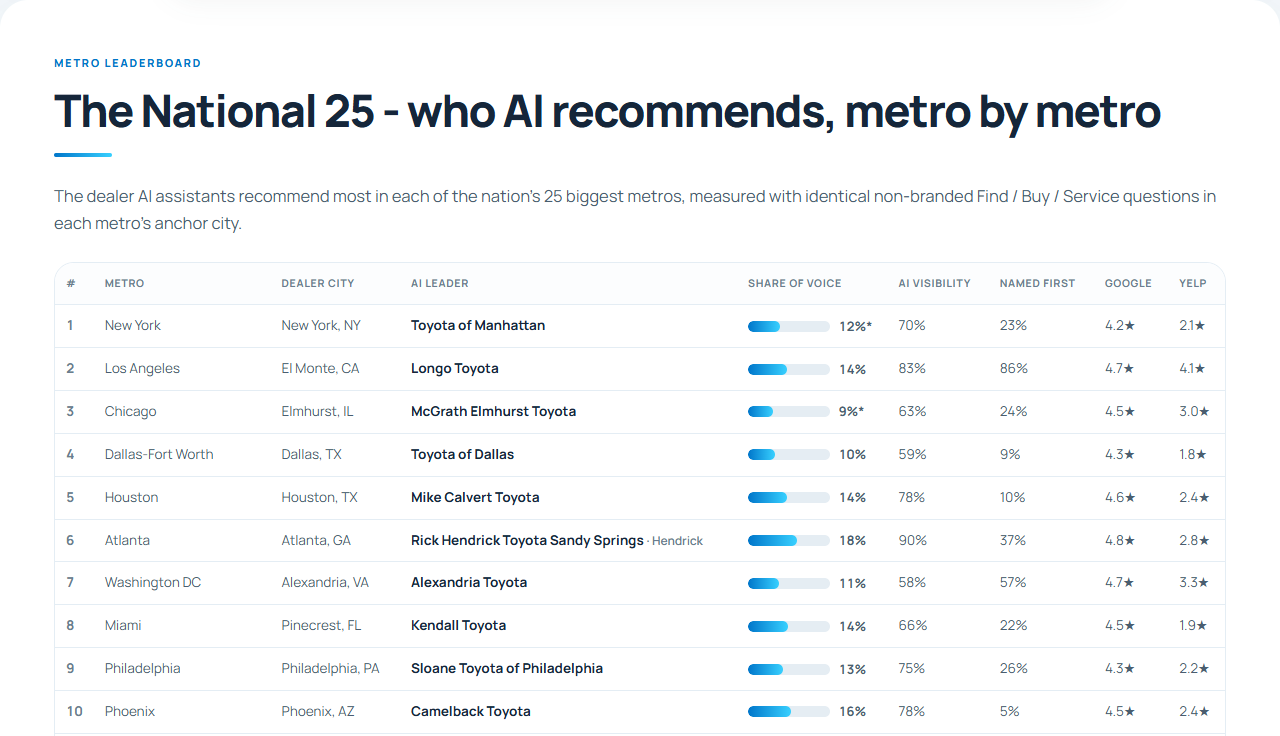
For the CarGenius Toyota National Dealer AI Visibility Report, we measured which Toyota dealerships AI assistants recommended across the 25 largest U.S. metro areas using identical non-branded Find, Buy, and Service questions.
Then we compared the dealerships leading each market with their Google and Yelp ratings.
The gap was hard to miss.
Sixteen of the 25 metro AI leaders had Yelp ratings below 3 stars. At the same time, the AI-leading dealers averaged 4.5 stars on Google.
That gives us an important reality check: a low Yelp rating does not automatically keep a dealership out of AI recommendations. Toyota of Dallas, for example, led the Dallas-Fort Worth market in the CarGenius measurement despite having a 1.8-star Yelp rating.
But that does not make Yelp irrelevant. In the same national study, Yelp represented 3.3% of all citations from the AI assistants we measured.
Why are dealership Yelp ratings often so much lower?
There probably is not one explanation. But two differences stand out: the service drive and the way Yelp handles review solicitation.
Service creates more opportunities for things to go wrong
A customer might buy a vehicle once every five or seven years. That same customer can return to the dealership for service again and again.
Every visit creates another opportunity for a communication problem, unexpected charge, diagnostic disagreement, parts delay, warranty issue, or long wait.
Widewail found that 43.7% of negative dealership reviews mentioning a department involved service, more than any other dealership department.
Yelp does not work like your Google review program
Many dealerships have mature processes for generating Google reviews after a sale or service visit.
Yelp explicitly tells businesses not to ask customers to leave Yelp reviews. Its automated recommendation software also looks at signals related to review quality, reliability, and reviewer activity.
That creates a different environment from a platform where a dealership actively sends review invitations to thousands of customers.

What about the idea that Yelp is “pay-to-play”?
This is worth addressing because many dealers have heard the argument, and many have had enough Yelp advertising calls to be skeptical.
But advertising and reputation should be treated as two separate decisions.
Yelp says its review recommendation software treats advertisers and non-advertisers the same. There is no evidence that a dealer needs to buy Yelp ads because of ChatGPT.
AI can learn more from reviews than a star average
Dealers naturally focus on the number. A 2.8 versus a 4.6 feels easy to understand.
But the text underneath the rating can be just as interesting in an AI search environment.
- “Which dealer has the most transparent pricing?”
- “Where can I buy without getting pressured in finance?”
- “Which dealer has good service communication?”
- “Who explains repair costs before doing the work?”
Those questions are difficult to answer from a star average alone. Customer reviews contain the details.
OpenAI has not published a formula showing that repeated mentions of “transparent pricing” will move one dealer ahead of another. We also do not know how much weight Yelp receives compared with other sources for any particular dealer recommendation.
But the direction is clear: AI has access to more of your reputation than a single star rating.
Start thinking about your “AI reputation footprint”
Yelp should not become your entire AEO strategy. The more useful idea is to look at the collection of information an AI assistant can find about your store across the web.
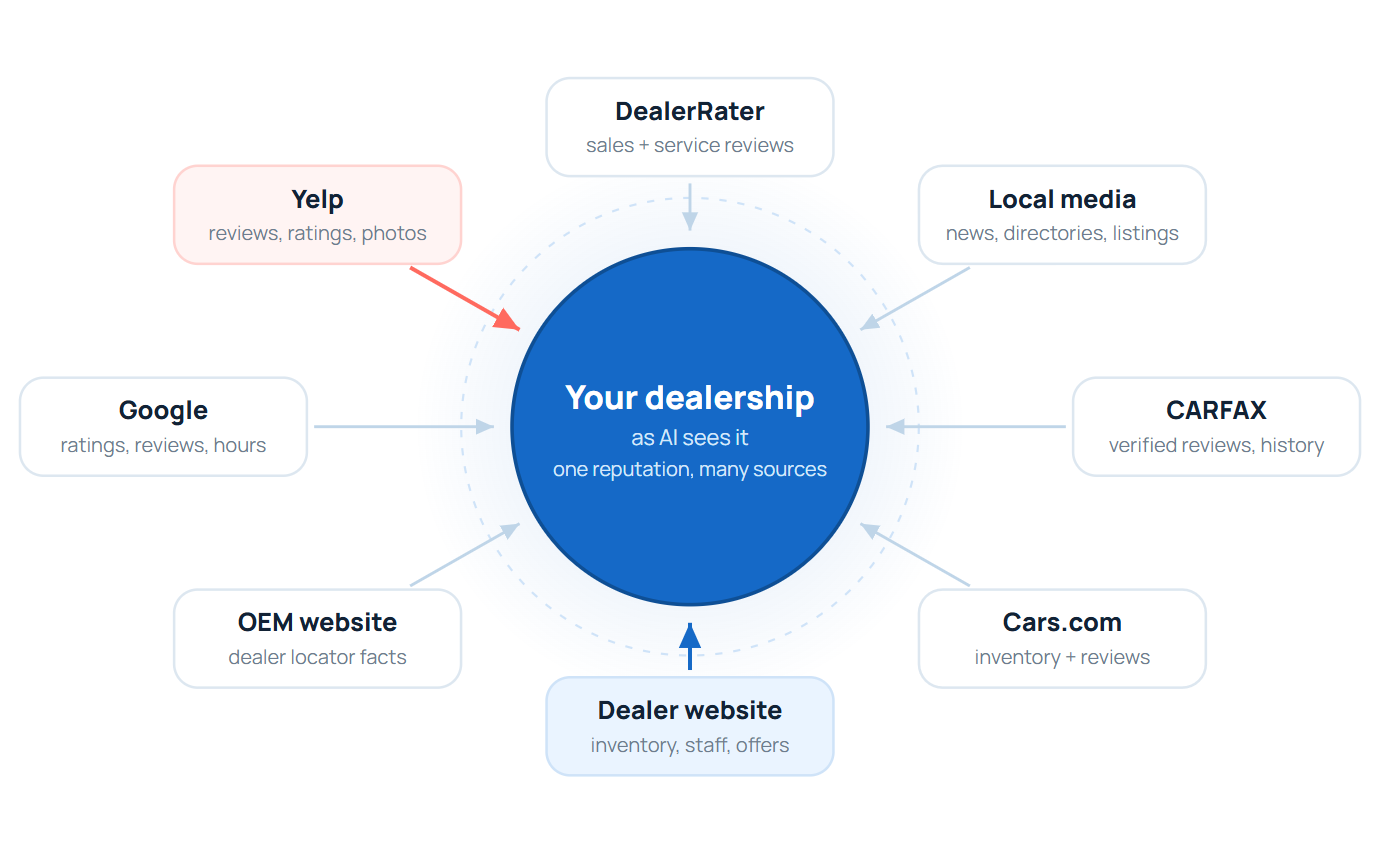
If your dealership has 4.8 stars on Google and 2.6 on Yelp, the answer is not to dismiss Yelp because Google looks better.
Ask why the difference exists. Maybe the Yelp profile is old. Maybe the sample is small. Maybe several unusual complaints distorted the score. Or maybe customers are repeatedly describing an operational problem that deserves attention.
You do not need every website to tell exactly the same story. But you should know when an important source is telling a very different one.
What dealers should do about Yelp now
The good news is that this does not require a new six-figure marketing program. Start with the basics.
Don't optimize Yelp in a vacuum
A dealer might spend months improving its Yelp rating and still learn very little about whether the work changed AI visibility.
The metric that ultimately matters is not “Did our Yelp score go up?” It is: When shoppers ask AI where to buy or service a vehicle in our market, are we recommended?
Yelp matters more now, but it is still only one piece of AEO
The OpenAI-Yelp relationship does not make Yelp the single most important ranking factor for car dealers. There is no evidence for that.
Our own Toyota measurement reinforces the point. Some of the dealers AI recommends most have weak Yelp scores. Geography, third-party sources, reputation, dealer information, and other factors can all contribute to the answer.
But Yelp now deserves more attention than many dealers have historically given it.
The reason is not Yelp traffic. It is data distribution.
A review written on Yelp can now reach a shopper inside ChatGPT. A business detail maintained on Yelp can potentially appear in an AI-powered local experience. The detailed customer experiences sitting inside your Yelp profile are now available to one of the most widely used AI assistants.
That is the larger AEO lesson: your dealership’s reputation no longer lives on one website at a time.
Sources
Meta Muse: From AI that answers to AI that acts
Meta's new personal AI agent, Muse, takes on tasks instead of answering questions. We gave it a dealership MCP server: it searched live inventory and submitted a lead. What that means for dealers when the next shopper is an agent.

Jev and the Falling Cost of AI Intelligence
We tested TypeSafe's new decision model, Jev, on real CarGenius workloads. The results point to a future where specialized AI makes a much larger class of software automation practical.
of car shoppers now start with AI
higher conversion with AI search
instant answers for every shopper
Stay ahead of the curve
Get weekly insights on AI, automotive commerce, and dealer tech delivered to your inbox.