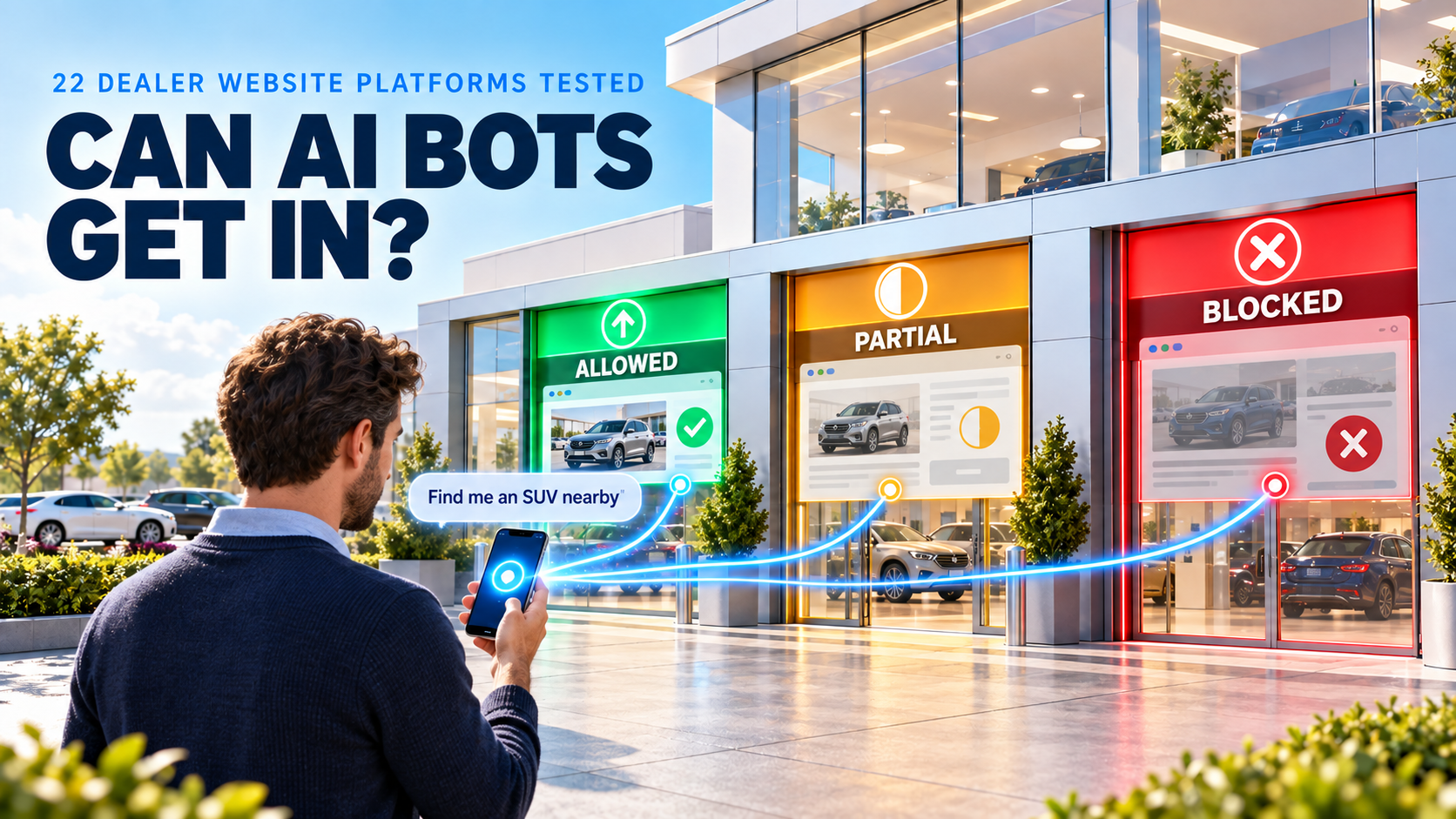
In September, Google began presenting shoppers with more dealership details directly inside its AI answers, including review counts, hours and side-by-side comparisons. In October, we observed three more changes that could affect which dealerships shoppers consider and where they go next.
ChatGPT started asking shoppers to narrow their search. Yelp business profiles began showing up in ChatGPT's cited sources. And Google began listing its own Maps directions links among the sources for local dealership answers, often ahead of dealership websites.
These changes happened on different dates and across different AI products. They do not mean that every dealership's AI visibility rose or fell. They do show why dealers need to look beyond a single ranking or traffic number to understand how AI is presenting their business.
Each figure describes the share of recorded AI answers showing a particular behavior, not a share of shoppers, clicks or dealership recommendations. Comparison periods differ because the changes happened at different points in October.
ChatGPT is turning dealership searches into guided interviews
Until early October, ChatGPT generally responded to a dealership question with a recommendation and a short explanation. Now it often follows that answer with a series of targeted questions, turning the search into a guided interview: what vehicle the shopper wants, how much they want to spend or what kind of service they need.
We first reported the October 8 shift in a separate CarGenius Insights article. The new finding is how far the pattern has spread since then. Before October 8, just 0.5% of tracked ChatGPT answers asked a qualifying follow-up question. The rate reached 44% from October 8 through 28, then 65% from October 29 through November 1. A separate November 3 collection showed a similar rate of 68%.
Nov 3 follow-up sample: 68%. Date windows are not full calendar-month averages.
The questions tend to follow the shopper's original request. In the late-October sample, approximately 90% to 93% of service-related answers asked a follow-up, often about the work needed or the vehicle's year. For questions about the best dealership to buy from, the rate was 77%, frequently asking about the desired model, budget or whether the shopper wanted a new or used vehicle.
Importantly, ChatGPT was not simply postponing its answer. Among responses that asked a question, 99% still named at least one tracked dealership. And 26% of the late-October answers contained answer choices under a question, such as budget ranges or types of service. The text records do not establish whether those choices appeared as interactive buttons in every case.
A financing question shows why the next step matters
Consider a shopper who has already received a dealership recommendation. ChatGPT might then ask how they intend to pay: cash, financing or leasing. The example below shows that question appearing as part of a larger vehicle-shopping exchange.

That question can change who helps the shopper take the next step. If the shopper selects financing, ChatGPT could recommend a third-party option such as Capital One Auto Navigator rather than send them directly to the dealership's financing process. A third-party lender may still work with the dealership, but the shopper's next interaction could happen elsewhere.
This is why guided AI shopping matters beyond the initial recommendation. Dealers need to make useful, current information available throughout the process: inventory and vehicle prices, financing and lease options, trade-in tools, service capabilities, and clear steps for moving toward a purchase. Secure application steps can stay in the dealership's approved systems, with AI directing shoppers to the right place.
ChatGPT started citing Yelp business profiles
ChatGPT was already using Yelp information before October. Through the OpenAI-Yelp partnership, Yelp ratings, reviews and business details were available to support local business recommendations, including ChatGPT's map-based results. As we explained in our earlier article on why Yelp matters for dealerships, a shopper did not necessarily have to open Yelp to encounter its information in ChatGPT.
What changed in October was where Yelp appeared in the answer. Direct links to Yelp business profiles began showing up in ChatGPT's cited sources for the local dealership questions CarGenius tracks. They were almost absent from the recorded citation lists through October 13, appeared around October 14 and became more consistent by October 17. This is a change in visible source citations, not the date ChatGPT first began using Yelp data.
From October 17 to November 1, 6.8% of tracked ChatGPT answers cited at least one Yelp page. Nearly all of those citations, 99%, pointed to individual business profiles rather than general Yelp search pages.
*Oct 17–Nov 1 pooled answers. Daily percentages vary with the changing tracked groups.
Service questions were a particularly common place to find Yelp. Around 9% to 10% of answers to the two tracked service-question types cited a Yelp page. Some of those sources covered independent repair businesses as well as franchised dealerships.
One detail is easy to miss: only 1% of answers citing Yelp actually said “Yelp” in the answer text. Many included a star rating, but the source of any particular rating cannot be established from that fact alone. A dealer reviewing the answer would often need to open its source markers to see whether Yelp was cited.
Yelp has not replaced other review or automotive sources. It remained a minority citation source in the tracked answers. The important development is that Yelp now has two visible roles in ChatGPT's local-shopping experience: supplying business information and appearing as a directly cited source. Dealers should keep their Yelp profiles accurate, especially service details and responses to customer complaints. The cited URLs were also consistent with information delivered through Yelp's OpenAI feed, although the recorded answers do not establish how every page reached ChatGPT.
Google AI now cites itself: its own Maps listing comes before your website
The largest change in source presentation arrived at the end of the month. Starting October 30, Google AI Mode and AI Overviews began including Google's own Maps directions links in the cited-source lists for dealership answers.
Before then, Maps cards were already part of many AI answers, but their directions links were rarely recorded as cited sources. In the September 1 to October 29 period, the share was 0.1% in AI Mode and effectively zero in AI Overviews. From October 30 through November 1, it jumped to 73% in AI Mode and 66% in AI Overviews. A separate collection on November 3 recorded 88% and 87%, respectively.
Separate Nov 3 sample: AI Mode 88%, AI Overviews 87%.
Those Maps links often move into the first cited-source position. In the initial late-October collection, a Google Maps directions link was the first citation in 56% of AI Mode answers with a source and 57% of AI Overview answers with a source. It is a shift in the order of the links a shopper is offered, even if the dealership itself is still recommended.
The full screenshot shows the AI-generated dealership recommendations alongside the sources panel. The highlighted entries on the right are labeled Google, rather than links to the dealerships' websites.

What the October changes mean for dealers
These three developments affect different parts of a dealership search, and they should not be treated as one measured shopping journey. But together they suggest three places where a dealer should pay attention.
ChatGPT now asks about budget, payment method and service needs, creating new moments when outside tools may enter the conversation.
Yelp can both supply information to ChatGPT's local results and appear as a direct citation.
Google's own Maps links are taking prominent places among cited sources.
The immediate opportunity is to make the information a shopper might need clear and consistent across your website and your business profiles. The risk is assuming that being mentioned in an AI answer, having your website cited and receiving a website visit are all the same outcome. They are not.
What dealers should check this month
Test the full conversation.
Start with a common buying or service question, then follow ChatGPT's prompts about budget, financing or trade-ins. Record whether it still directs the shopper to your dealership and which outside services it suggests.
Review both reputation profiles.
Verify Google Business Profile and Yelp details, including any separate service listing. Review feedback and correct stale hours, contact information or photos.
Make the next steps easy to find.
Keep vehicle inventory, prices, financing and leasing options, trade-in tools, service pages and appointment links current. Give shoppers and AI assistants clear paths to the dealership's approved tools and secure forms.
Check where the AI links go.
Look at Google AI Mode and AI Overviews for local dealership searches. Record whether your store is named, whether its website is cited, and whether the first link points to Google Maps.
See what AI says about your dealership
CarGenius Dealer AI Visibility Reports measure which dealerships AI assistants actually name when shoppers ask non-branded Find, Buy, and Service questions, which competitors win those recommendations, and which sources are shaping the answers. See where your store stands.
View the Visibility ReportsGet a Custom ReportOr book a demo →CarGenius reviewed recorded answers to recurring local questions about finding, buying from and servicing at dealerships across multiple metropolitan markets. The analyses use first-response records from ChatGPT, Google AI Mode and Google AI Overviews. Observations span August through early November 2026, with some Google comparisons extending into July. The collection rotates through different market and question groups, so the charts show defined before-and-after periods rather than full calendar-month averages or a controlled test of one identical set of questions.
For shopper follow-ups, the main comparison windows are August 1–October 7, October 8–28 and October 29–November 1. The Yelp citation comparison uses August 1–October 13 and October 17–November 1. Google's Maps-link comparison uses September 1–October 29 and October 30–November 1, with a separate November 3 follow-up check. Answers can contain cited-source markers and in-text website links; the charts here measure recorded citations unless otherwise noted. This data does not measure shopper clicks or which dealerships appear after a second conversational turn.